Remote check-in vs in-person in tourist accommodation: which to choose based on your case
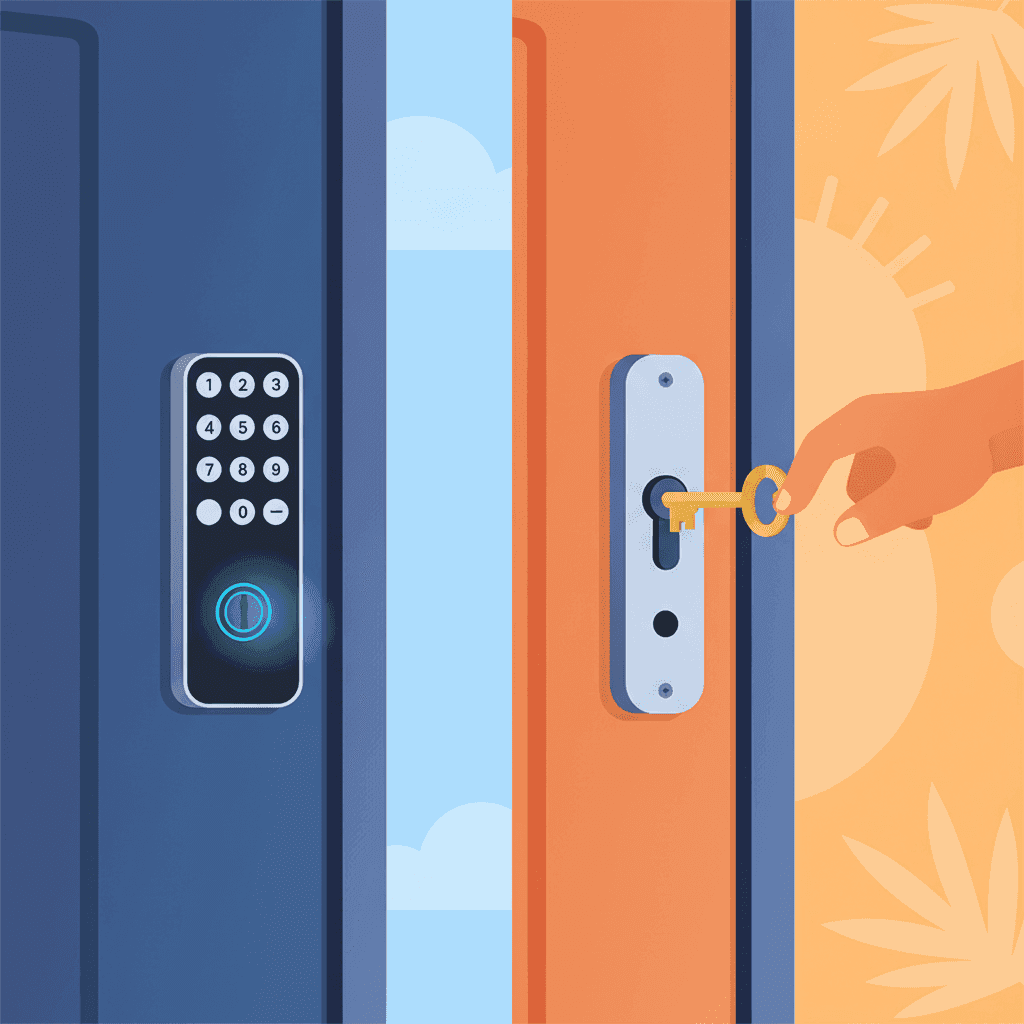
The debate between remote and in-person check-in is not just a matter of convenience. It affects your costs, your reviews, your free time, and even the type of guest you attract. In this article, we compare both options with real data, specific cases, and a table so you can decide which best fits your tourist accommodation in Spain.
What is each type of check-in (and why the difference matters)
In-person check-in is the traditional one: you (or someone from your team) wait for the guest at the door, give them the keys, show the apartment, and answer questions in person.
Remote check-in is contactless: smart lock, key box with code, lockbox, or smart lock. The guest arrives, enters the code, and enters. End.
It may seem like a small difference, but it completely changes how you operate your property. And there is no universal answer: it depends on your property type, location, and guest profile.
In-person check-in: when does it make sense?
In-person is not dead. In fact, in certain cases, it is the best option.
Advantages of in-person check-in
- Filters problematic guests. Seeing a face tells you a lot. If 8 people arrive when 4 were booked, you find out immediately.
- Reduces damages and misunderstandings. You explain how the stove, boiler, air conditioning work. Fewer calls afterward.
- Better sell your apartment. You can suggest restaurants, activities, and details that guests appreciate (and mention in reviews).
- Detects problems before they escalate. If something doesn’t work, you find out instantly and not when you already have a 3-star review.
Disadvantages
- Ties you to schedules. If the guest’s flight is delayed 3 hours, there you are waiting.
- High cost if delegated. A professional meet and greet costs between 20 and 40 euros per check-in.
- Does not scale. With 1 or 2 floors, it’s fine. With 5, you go crazy.
- Schedule conflicts. Two check-ins on the same day at similar times, and you have a problem.
If you value your time at 20 euros per hour and do 15 check-ins a month that take 45 minutes each (including travel), you are spending 225 euros a month just in time. Do the math before deciding.
Remote check-in: when does it make sense?
Remote has become hugely popular in recent years, and for good reason. But it’s not a panacea.
Advantages of remote check-in
- Total schedule freedom. The guest arrives when they can, you sleep peacefully.
- Scalable. You can manage 10 apartments just like 1.
- Minimal cost. A decent smart lock costs between 100 and 250 euros and lasts for years.
- Less friction for the guest. Many travelers prefer not to coordinate schedules with anyone.
Disadvantages
- Less control over who enters. You don’t visually verify if they are the ones who booked.
- More WhatsApp inquiries. The guest asks how everything works from the sofa.
- Dependence on technology. If the WiFi of the lock fails or the battery runs out, you have a problem.
- Worse first impression if something fails. If they can’t find the lockbox, they start the stay annoyed.
Comparison: in-person vs remote
| Aspect | In-person | Remote |
|---|---|---|
| Initial cost | Low (0 euros) | Medium (100-250 euros per lock) |
| Recurring cost | High (your time or 20-40 euros per check-in) | Very low |
| Scalability | Low | High |
| Guest control | High | Low |
| Schedule flexibility | Low | Total |
| Technical risk | None | Medium |
| Impact on reviews | Positive (if goes well) | Neutral (if goes well) |
| Ideal for | 1-2 floors, owner nearby | 3+ floors, owner far away |
The hybrid model: the best of both worlds
Many experienced owners use a mixed system. Remote check-in by default, in-person when it makes sense.
When does the hybrid make sense?
- Large groups (more than 6 people): better to see them arrive.
- Long stays (more than 14 days): first impressions matter more.
- International guests without previous reviews: extra control doesn’t hurt.
- Weekend local events: when there’s a higher risk of parties.
The rest of the time, smart lock and move on.
Real costs (with numbers)
Let’s do an exercise with a property that rents 120 nights a year and has about 40 reservations annually.
Scenario A: Delegated in-person
- 40 check-ins x 30 euros = 1,200 euros per year
- No initial cost
Scenario B: Remote with smart lock
- Lock: 180 euros (amortized over years)
- Annual maintenance (batteries, some issues): 30 euros
- Total first year: 210 euros. Subsequent years: 30 euros
Scenario C: Hybrid
- Lock: 180 euros
- 10 in-person check-ins per year (large groups, etc.) x 30 euros = 300 euros
- Total first year: 480 euros. Subsequent years: 330 euros
The difference is huge. And we’re only talking about one property.
What you cannot forget (traveler registration)
Regardless of the check-in type you choose, you have a legal obligation: register all guests in SES Hospedajes and send the data within the first 24 hours of entry.
This applies whether you do in-person or remote check-in. If you skip this step, fines range from 100 to 30,000 euros. No joke.
If you do in-person check-in, you can collect the data and documents right there. If remote, you need a system for the guest to send their data before arrival (or upon arrival). Usually: an online form they fill out.
You can see more about this in our guide on how to automate check-in in your vacation rental and how to send traveler reports to SES Hospedajes.
Common mistakes when setting up remote check-in
1. Buying the cheapest lock
A 40-euro lock from an unknown brand is a ticking time bomb. When it fails (and it will), you lose the reservation. Invest in something decent: Nuki, Yale, TTLock.
2. No backup plan
What if the batteries run out just when the guest arrives at 23:00? Always need an accessible physical key. An emergency lockbox with a key can save you.
3. Confusing instructions
Guests arrive tired. If your instructions are a wall of text without photos, you’ll mess up. Send a message with a photo of the portal, a photo of the door, the highlighted code, and a short video if needed.
4. Not verifying identity
Remote makes it easy to forget to ask for ID/passport. But you must do it anyway for traveler registration. Ask for it before sending the access code.
5. Not changing codes
If you always use the same code, any old guest can re-enter. Change the code with each reservation. Good smart locks make this easy.
How to choose according to your case
Live near the apartment and only have one or two: try in-person. The cost of your time may compensate for control and better reviews.
Live far away or have multiple floors: remote without hesitation. The time you save is worth gold.
Your apartment attracts many young or party groups: hybrid with in-person on weekends. Filters problems beforehand.
Rent to families, remote workers, long stays: remote works great. These guests appreciate autonomy.
Starting out: in-person the first weeks to learn what guests ask and what fails. Then switch to remote with all the info you’ve gathered.
How Autoregistro fits in
Whether you do in-person or remote check-in, you must register travelers in SES Hospedajes. It’s the boring and mandatory part of hosting guests.
With Autoregistro, your guests fill out an online form with their data and documents before arrival. We automatically send everything to SES Hospedajes. You do nothing.
It costs 1 euro per month per property, less than a coffee. And saves you the hassle of manually entering data into the government platform or wasting time searching WhatsApp for passports.
It fits perfectly with remote check-in (guest fills out before, and you send the access code once you have their data), but also works well if you’re the type to open the door in person.
Frequently Asked Questions
Is it legal to do 100% remote check-in in Spain?
Yes, as long as you comply with traveler registration and verify the identity of all guests over 14 years old. The law does not require the owner to be physically present.
Which smart lock do you recommend?
Nuki, Yale Linus, and TTLock are the most reliable in Spain. Prices between 150 and 250 euros. Avoid unknown brands even if they are cheap.
Can I charge more for in-person check-in?
Check-in itself is not charged, but you can charge for extra services like early check-in or late check-out. We cover this in detail in the post about early check-in and late check-out.
What if the guest refuses to send their data in advance?
Explain that it’s a legal obligation in Spain (Royal Decree 933/2021). If they still refuse, you have the right to cancel the reservation without penalty. It’s not optional.
How long does a well-done in-person check-in take?
Between 20 and 40 minutes, depending on the size of the apartment and how much you want to explain. If it takes less, you’re probably not collecting data properly or not showing what’s important.
Related posts

Ready to automate your guest registration?
Create your account and start streamlining SES Hospedajes compliance for your Spanish rentals.
Get started