How to register your tourist rental property in Spain: step-by-step guide
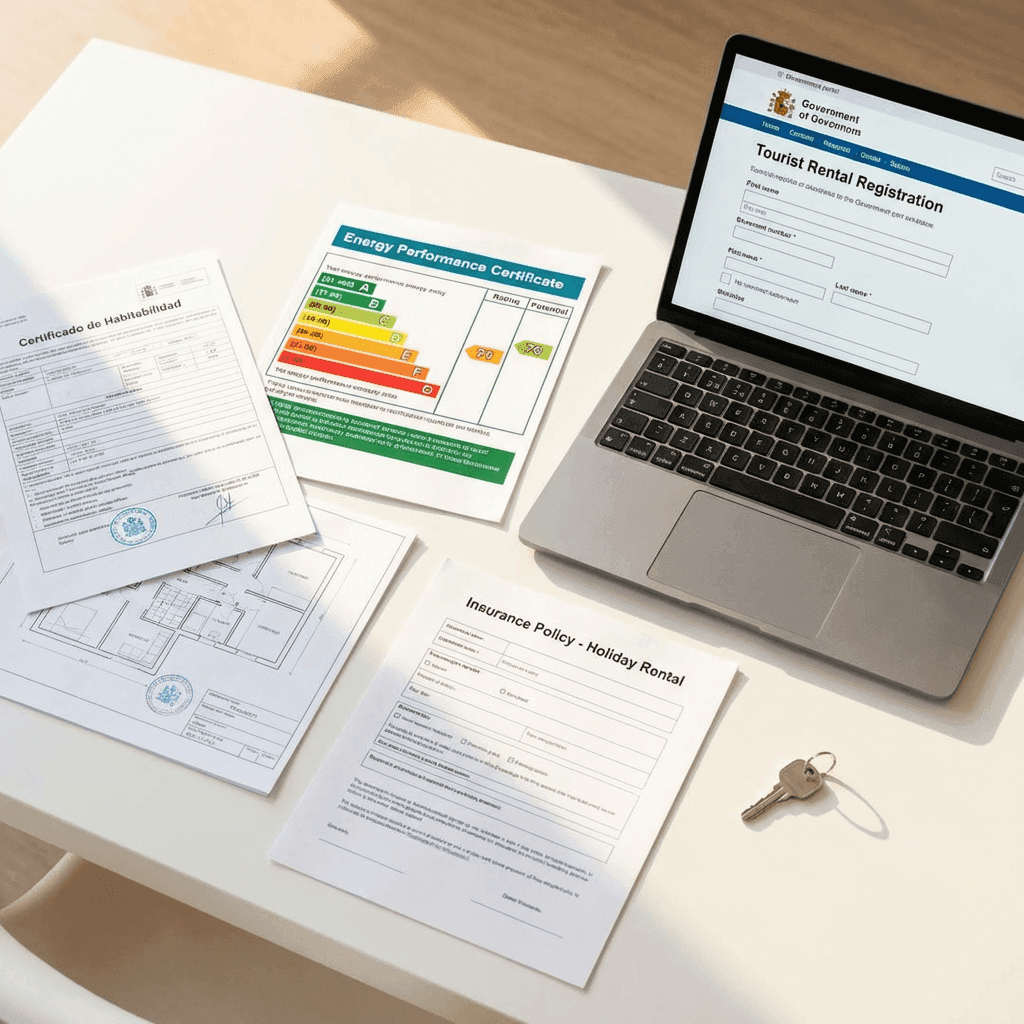
To register your tourist rental property in Spain you need to complete several steps in order: verify the property can be used for tourist rental, gather documentation (habitability certificate, insurance, energy certificate), file a responsible declaration with your autonomous community, obtain the national registration number, and register with SES Hospedajes. Only then can you legally list on platforms.
If you're thinking about renting your property to tourists — or you're already doing it without everything in order — this guide takes you from zero to your first legal booking. No shortcuts, no gaps, no surprises.
Before you start: can your property be a tourist rental?
Not every property can be used for tourist rental. Before spending time and money on paperwork, verify three things:
Regional and municipal regulation
Each autonomous community regulates tourist-use dwellings (VUT) independently. Some allow room-by-room rental, others only full properties. Some require minimum stays, others don't. And many municipalities have added their own restrictions: moratoriums, zoning, density limits.
Check your autonomous community's tourism website and your municipality's regulations before taking the first step. If you operate in an area with active restrictions (Barcelona center, Palma, Madrid Centro district), this step is critical.
For a detailed breakdown by territory, see our guide to requirements by autonomous community.
Homeowners' association
If your property is in a building with a homeowners' association (comunidad de propietarios), review the bylaws. Some associations have approved agreements that prohibit or limit tourist use. Since the 2019 reform of the Horizontal Property Law, a three-fifths majority can approve this limitation.
It's not an administrative procedure, but ignoring it can lead to costly legal disputes after you've invested in the registration.
Habitability conditions
The property must meet the minimum habitability conditions required by your territory. This includes minimum surface area, ventilation, installations in good condition, hot water, and basic kitchen and bathroom equipment. If the property doesn't have a current habitability certificate, you'll need to obtain one before continuing.
Step 1: Gather the documentation
The exact documentation varies by autonomous community, but the common core is:
Habitability certificate (or occupancy license)
Proves the property meets minimum conditions for habitation. If you don't have one, a technical architect can process it after inspecting the property. Cost varies between €100 and €300 depending on the community and professional.
In some communities, the first occupancy license or second occupancy license is accepted as equivalent. Verify which document your territory accepts.
Energy efficiency certificate
Required in most autonomous communities for tourist properties. Issued by a certified technician after evaluating the property. Valid for 10 years and costs between €80 and €200.
Beyond being a legal requirement, some platforms like Booking.com display the energy rating on the listing, which can influence the traveler's decision.
Civil liability insurance
Mandatory in all autonomous communities. Covers third-party damages from tourist activity. The usual minimum coverage is €150,000, though some communities require more.
You can take it out as a standalone policy or as an extension of your home insurance. Make sure the policy explicitly covers tourist rental activity — a standard home insurance policy usually doesn't.
Approximate cost: between €150 and €400 per year, depending on coverage and location.
Owner documentation
- DNI/NIE of the owner or legal representative
- Property deed or contract proving availability of the property
- If you're acting as a manager and not the owner: express authorization from the owner
Additional documentation by community
Some territories require specific documents:
- Valencian Community: urban compatibility certificate from the municipality
- Catalonia: prior notification to the municipality (not just the autonomous community)
- Balearic Islands: energy certificate mandatory in all cases
- Madrid: proof of independent access in certain zones
Check your territory's specific requirements before filing the declaration.
Step 2: File the responsible declaration
The responsible declaration (declaración responsable) is the most common procedure in Spain for registering a tourist property. It's not an authorization request — it's a declaration where you, as the owner, state that you meet all legal requirements and commit to maintaining them.
How it works
- Access your autonomous community's tourism registry (usually through their electronic office)
- Fill in the responsible declaration form for tourist-use dwellings
- Attach the required documentation
- Submit the declaration
In most communities, filing is done online with a digital certificate or Cl@ve. Some allow in-person filing, but the online process is faster.
What happens next
After filing, you receive a registration number from the regional tourism registry. In many communities, this number is assigned immediately or within a few days. This is your regional tourist license number.
Important: the fact that a responsible declaration doesn't require prior authorization doesn't mean there's no oversight. The administration can inspect at any time and, if it finds you don't meet the declared requirements, can penalize and revoke the registration.
Cost
Filing the responsible declaration is free in most communities. The real cost is in the prior documentation (habitability certificate, energy certificate, insurance).
Identification plaque
Many communities require placing an identification plaque at the property entrance with the registration number. The format and dimensions vary by territory. Some communities provide an official template; in others, you must order it yourself.
Step 3: Obtain the national registration number
Since July 2025, every short-stay property listed on digital platforms needs a national registration number, independent of the regional license. This obligation comes from Royal Decree 1312/2024.
Process
- Access the registration system established by the royal decree
- Identify yourself with a digital certificate or Cl@ve
- Enter the property data: address, cadastral reference, unit type, maximum capacity, owner details
- Provide your regional tourist registration number
- Receive a provisional number while documentation is verified
- Obtain the definitive number once everything is in order
Each rentable unit needs its own number. If you manage five apartments, you need five registrations.
Why it matters
Without this number, platforms can block your listing. Airbnb, Booking, Vrbo, and the rest are required to verify that the number exists and is valid before publishing the listing.
For more detail on this procedure, see our guide to the national tourist rental registry.
Step 4: Register with SES Hospedajes
SES Hospedajes is the Ministry of Interior's platform where you must report each guest's data. It's an obligation independent of the tourist license — regulated by Royal Decree 933/2021.
Registration process
- Access the SES Hospedajes portal
- Identify yourself with a digital certificate or Cl@ve
- Register your establishment with the property data
- The system assigns an establishment code
- Confirm you can submit test reports
From that point on, every time a guest checks in, you must submit their data to SES Hospedajes within 24 hours.
Territorial exceptions
- Catalonia: uses the Mossos d'Esquadra system, not SES Hospedajes
- Basque Country: uses the Ertzaintza system, not SES Hospedajes
In the rest of the national territory, SES Hospedajes is the mandatory system.
Practical tip
Set up at least two authorized users for your establishment. If the only administrator is unavailable, submissions stop. Or better yet, automate the process with a tool like Autoregistro so it doesn't depend on any specific person.
Step 5: Prepare the property
With the paperwork in order, it's time to prepare the property to receive guests. Beyond decoration and photos (which we cover in our guide to improving your listing), there are operational requirements you need to have ready:
Mandatory equipment
Regional regulation usually requires minimum equipment:
- Bed linen and towels
- Equipped kitchen with basic utensils (plates, glasses, cutlery, frying pan, pot)
- Hot water
- Climate control appropriate to the area (heating and/or air conditioning)
- First aid kit
- Emergency services information
Visible documentation
You must have available for guests:
- Complaint forms
- Contact phone number for the owner or manager
- Basic property instructions (WiFi, appliances, waste disposal)
- Tourist information about the area (recommended, not always mandatory)
- Identification plaque at the entrance with the registration number
Safety
- Fire extinguisher (mandatory in some communities)
- Smoke detector (recommended, mandatory in some territories)
- Evacuation instructions if the building has them
- Locks in good condition
Step 6: Publish your listing
With everything in order, you can now list on platforms. When creating the listing:
- Include the national registration number in the platform's corresponding field
- Include the regional tourist registration number if the platform requests it
- Make sure the advertised capacity matches the declared capacity
- Verify that the address and listing data are consistent with the documentation
Platforms verify the registration number before publishing. If there are discrepancies between the listing data and the registry data, the listing may be rejected or blocked.
The complete timeline: how long does it all take
Being realistic, the complete process from zero to first legal booking can take between 2 and 8 weeks, depending on your autonomous community and whether you already have the base documentation:
| Procedure | Estimated time |
|---|---|
| Habitability certificate | 1-3 weeks |
| Energy certificate | 1-2 days |
| Civil liability insurance | 1-3 days |
| Regional responsible declaration | Immediate to 2 weeks |
| National registration number | 1-4 weeks |
| SES Hospedajes registration | 1-2 days |
| Property preparation | Variable |
| Listing creation | 1-2 days |
The bottleneck is usually the habitability certificate (if you don't have one) and the national registration number (depending on application volume).
Approximate total cost
| Item | Approximate cost |
|---|---|
| Habitability certificate | €100 - €300 |
| Energy certificate | €80 - €200 |
| Civil liability insurance (annual) | €150 - €400 |
| Responsible declaration | Free (most communities) |
| Identification plaque | €20 - €60 |
| Professional photography | €100 - €300 |
| Initial total | €450 - €1,260 |
This doesn't include the cost of furnishing or equipping the property, which varies enormously depending on the starting condition.
Mistakes that delay or block the process
- Starting with the listing. Publishing before having documentation in order is the fastest way to get a platform block or an administrative penalty.
- Not checking municipal regulation. The autonomous community gives you the general framework, but your municipality may have additional restrictions that invalidate the entire process.
- Inconsistent data. If the address on the habitability certificate doesn't match the registry, or the declared capacity doesn't match the listing, you'll have problems. Check consistency before filing.
- Forgetting insurance. It's mandatory in all communities and one of the first things checked in an inspection.
- Not registering with SES Hospedajes. Many hosts complete the tourist registration but forget about guest registration. They're independent obligations and both are enforceable from the first guest.
- Managing everything on paper. With one property it can work. With several, it's unsustainable. The sooner you systematize, the fewer mistakes you'll make.
After registration: recurring obligations
Registering the property isn't a one-time procedure. Once operational, you have ongoing obligations:
- Guest registration: submit each guest's data to SES Hospedajes within 24 hours of check-in
- Retention of signed forms: for at least 3 years (more detail here)
- Annual informative declaration: each February, report the previous year's activity (from 2026)
- Insurance renewal: keep the civil liability policy current
- Data updates: report any changes in ownership, capacity, or property conditions
- Tax obligations: declare tourist rental income (IRPF, VAT where applicable)
How Autoregistro simplifies the day-to-day
The property registration process is a one-time effort. What actually consumes time is the daily operation: collecting each guest's data, verifying documents, submitting reports to SES Hospedajes, managing signatures, archiving records.
Autoregistro automates exactly that layer:
- The guest receives a link and completes their data before arriving
- Documents are scanned and validated automatically
- Reports are formatted and submitted to SES Hospedajes without manual intervention
- Digital signatures are collected and archived with each booking
- The history stays accessible for inspections throughout the legal retention period
You handle registering the property and keeping documentation up to date. Autoregistro handles making sure every guest is properly registered from day one.
Related posts
Guest registration in Spain: a practical guide for property managers
Everything property managers need to know about Spain's mandatory guest registration — the legal framework, the SES Hospedajes platform, and how to build a workflow that actually scales.
Spain's single rental registry: what property managers need to know
A practical breakdown of Spain's national short-term rental registry — who needs a number, how to get one, key deadlines, and what happens if you ignore it.

Spain's Property Registry for tourist rentals
Complete guide to Spain's Property Registry and its importance for vacation rental managers: what to check, how to process it, and common mistakes.

Vacation rental requirements by autonomous community in Spain
Detailed guide to the requirements each Spanish autonomous community demands to operate a vacation rental: licenses, responsible declarations, deadlines, limits, and key particularities.
Ready to automate your guest registration?
Create your account and start streamlining SES Hospedajes compliance for your Spanish rentals.
Get started