International Guests in Your Tourist Accommodation: Languages, Adaptations, and Common Mistakes
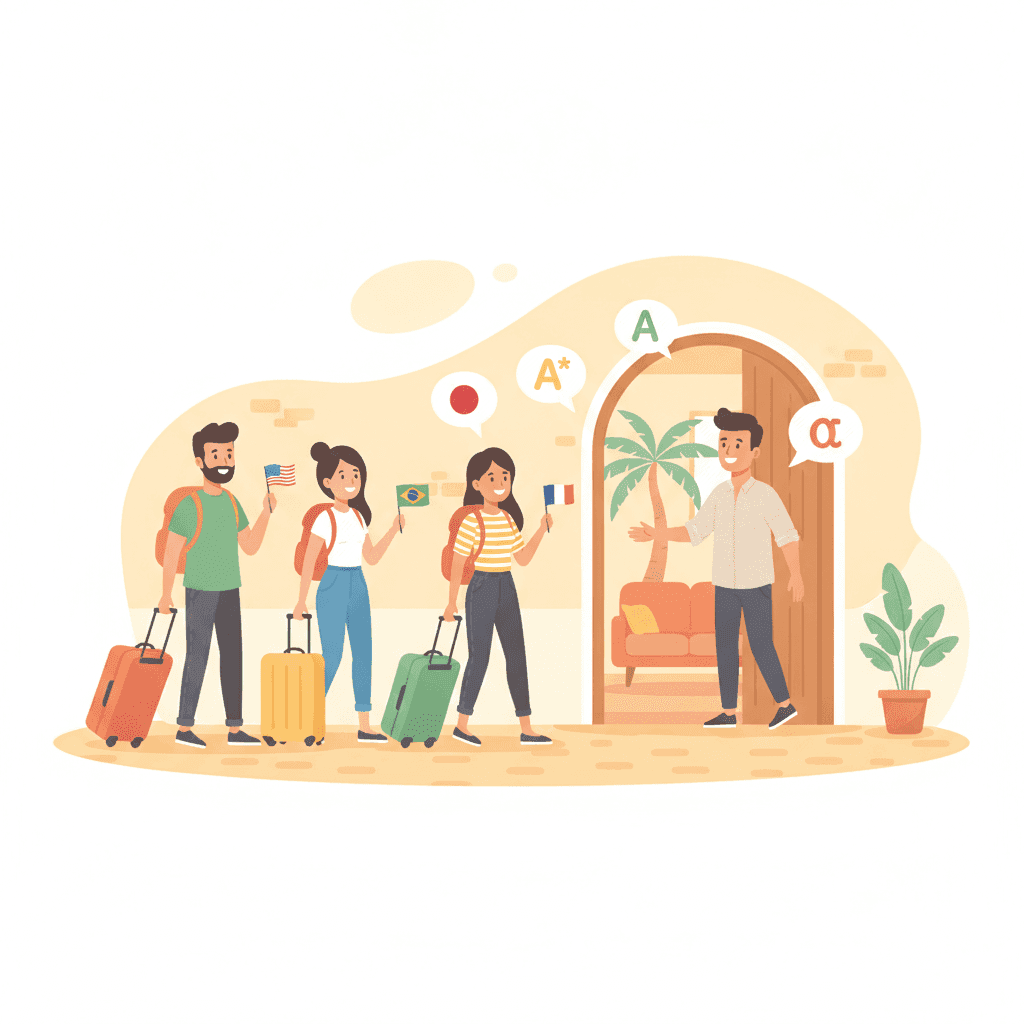
If you rent out your tourist accommodation in Spain, sooner or later you'll receive guests who don't speak Spanish. In fact, in many coastal areas and large cities, more than 70% of bookings come from abroad. Each nationality has its quirks, expectations, and ways of understanding what makes a good stay. This guide explains how to prepare for international guests without losing your mind: what languages to cover, what adaptations to make in the house, what to expect from each market, and common mistakes that cost you reviews.
Why this matters (and a lot)
A German guest and a Brazilian guest are not looking for the same thing. They don't expect the same. And they don't complain about the same.
If you treat everyone the same, you'll disappoint someone. And in the world of reviews, disappointment means losing money. A 4-star review on Airbnb can lower you in the algorithm and cost you hundreds of euros per month.
The good news: adapting doesn't cost much. Most adjustments are free or almost. You just need to know what to do.
Where your guests come from in Spain
According to data from the INE in recent years, the main source markets for Spain are:
| Country | Approximate % of total | Typical profile |
|---|---|---|
| United Kingdom | 20-22% | Families, couples, retirees. Very price-sensitive |
| Germany | 12-14% | Demanding about cleanliness and functionality |
| France | 10-12% | Seek authenticity and good cuisine |
| Netherlands | 6-8% | Direct, practical, speak perfect English |
| Italy | 5-7% | Sociable, large families |
| United States | 4-6% | Expect hotel-like comfort |
| Nordic countries (Sweden, Norway, Denmark) | 4-5% | Very quiet, value design |
| Portugal | 3-4% | Easygoing, not very demanding |
It depends a lot on your area. In the Balearic Islands and Canary Islands, British and Germans dominate. In Barcelona and Madrid, it's more varied. On the Levantine coast, there are many French and Nordic guests.
Which languages you need to cover
You don't need to speak five languages. But your accommodation should "speak" several.
The minimum essential: English
If you can only cover one foreign language, make it English. Period. 80% of international guests understand it, even if it's not their native language.
Everything written should be in Spanish and English:
- Welcome manual
- Appliance instructions
- House rules
- Wi-Fi and passwords
- Emergency contacts
- How air conditioning, heating, etc., work
The next level: French and German
If your area receives many guests from France or Germany (Costa Brava, Balearic Islands, Canary Islands), having the manual also in these languages helps a lot. These guests appreciate seeing content in their language, even if they speak English.
How to translate without spending a fortune
- DeepL: much better than Google Translate for long texts. Free for basic use.
- ChatGPT or Claude: perfect for adjusting tone, not just translating word for word.
- Trusted native speaker: if you have a friend or acquaintance, ask them to review. Usually takes about 30 minutes.
Beware of literal automatic translations. A "no smoking in the house" translated poorly can sound aggressive or even ridiculous. Always review what you publish.
How to communicate before arrival
This is where the difference is most noticeable. A well-written message in the guest's language builds trust from the first minute.
I recommend having templates saved in 3-4 languages for key messages:
- Booking confirmation
- Check-in instructions (2-3 days before)
- Welcome message on arrival day
- Check-out reminder
- Review request
If you use a channel manager or messaging tool, you can automate all this according to the guest's language.
Practical adaptations in the house
Plugs and adapters
In Spain, we use type F plugs (two round pins). British, Irish, and Swiss guests come with other formats.
Leave 2-3 universal adapters in a visible drawer. They cost 5-10 euros each and will definitely prevent complaints.
Coffee makers
Italians want moka or espresso. Americans want drip coffee. French guests are more relaxed. British guests also want tea.
Practical solution: capsule coffee machine (Nespresso or Dolce Gusto) + electric kettle + basic tea bags. Covers 90% of cases. You can read more in the guide to coffee makers for tourist accommodation.
Beds
Americans and British are used to larger beds (queen and king). If you can offer a 160 or 180 cm bed in the main bedroom, you'll earn points.
Nordic guests usually prefer two single beds together rather than a double. It's a real cultural difference. If your property is Nordic-friendly, keep this in mind.
Air conditioning and heating
British and Nordic guests look for warmth but like to sleep with fresh air. Germans highly value being able to control the temperature. Americans expect powerful air conditioning always available.
Ensure that the instructions for A/C and heating are in multiple languages and very clear. This is one of the top 3 reasons for complaints.
Shower vs. bathtub
Guests with small children (many French, Germans, British) highly value having a bathtub. If you only have a shower, state it clearly in the listing to avoid surprises.
Kitchen
- Americans: expect powerful microwave, abundant ice, lots of fridge space
- Italians and French: value a good kitchen with decent utensils
- Germans: want a filter coffee maker or at least a kettle
- Nordic: cook less, eat out more
Having basic utensils well thought out helps everyone. More ideas are in the post about kitchen utensils.
Cultural differences that often surprise
Meal times
In Spain, we dine at 9:30 or 10:00 pm. In Germany, at 6:00 pm. In the UK, at 7:00 pm. In France, around 8:00 pm.
This affects check-in times, neighbor noise complaints, and expectations of quiet at night. Explain this in the welcome manual.
Noise and schedules
Nordic and German guests are very sensitive to noise. If your apartment is in a noisy area, mention it in the listing. Don't hide it.
Italian and Latin American guests tend to make more noise themselves. Clearly state rules about schedules and coexistence. You can learn more in how to control noise.
Shoes inside the house
In Nordic and Asian countries, removing shoes upon entering is normal. If you leave a large doormat and slippers, many guests will appreciate it. Not mandatory, but adds value.
Tips
Americans are pre-programmed to tip. If you have cleaning service, some leave 20-30 euros. Don't count on it, but it's good to have an envelope "for the cleaning person" if they want to leave something.
Traveler registration: same process, different documents
This is the same for everyone, but the documents vary:
- EU and Schengen area: ID card or passport
- Rest of the world: passport required
- Minors: also need to be registered (see the minor registration guide)
With international guests, it's even more important to have a clear and digital check-in process. Asking for passport photos via WhatsApp works poorly. An online form in multiple languages is much more professional.
Common mistakes with international guests
1. Listing only in Spanish
If your listing on Airbnb or Booking is only in Spanish, you're missing 70% of the market. Write the description in English at least, and translate into French and German if your area justifies it.
2. Not replying to messages in English
Some owners reply in Spanish to messages in English expecting Google Translate to fix it. Wrong approach. Use DeepL or ChatGPT and reply in their language.
3. Ignoring time zone differences
An American might message you at 3 am Spanish time. A Japanese at 4 am. Set up automatic messages to reassure until you respond.
4. Welcome manual only in Spanish
The most common mistake. If you don't have it in English at least, do it today. You can do it in an afternoon with DeepL or ChatGPT.
5. Assuming local knowledge
Guests don't know that bread is bought at the bakery, not the supermarket, that pharmacies have strange hours, or that the metro closes at 1:30 am. Include these details in your manual.
6. Not warning about cultural peculiarities
Siesta, shutters always down at noon in summer, bars that don't accept cards under 5 euros... Small details that prevent misunderstandings.
What to add to your welcome manual
A good international manual should include:
- How to get from the airport and station (with options and prices)
- How the air conditioning and heating work (with photos)
- Visible Wi-Fi and password
- Nearby restaurants with Spanish hours explained
- Closest supermarkets and pharmacies
- Basic public transportation
- Emergency numbers (112 main)
- Recycling rules (a novelty for many foreigners)
- Quiet hours and coexistence norms
- What to do with keys when leaving
All in 2-4 languages depending on your audience. More details in the post about welcome manual.
How Autoregistro fits in
When you host many nationalities, the SES Hospedajes registration gets complicated: different document types, expiration dates, formats.
Autoregistro is designed for this. The guest fills out an online form (in their language), uploads a photo of their passport or ID, and the data is automatically sent to SES Hospedajes in the correct format.
It costs 1 euro per month per accommodation. Less than a coffee. And you avoid errors in transcribing Chinese, Japanese, or Russian passports, which often cause issues.
Frequently Asked Questions
Do I have to speak the guest's language?
No. With translators like DeepL or ChatGPT, you can manage communications in any language without speaking it. The important thing is that the guest receives clear messages in their language.
Is it worth translating the Airbnb listing into multiple languages?
Airbnb already translates automatically, but the translation is usually mediocre. If you have time, upload your own version in English at least. It increases conversions.
What if a guest doesn't speak English or Spanish?
It's rare but happens (Chinese, Japanese, Korean, Russian). Use Google Translate in real-time for conversations or WhatsApp with built-in translation. And keep the manual with many photos: an image is worth more than a thousand poorly translated words.
Do international guests leave better or worse reviews?
Depends on the nationality. Germans are strict but fair. Americans tend to be generous with stars. French are more critical of details. Overall, if you meet expectations, everyone leaves a good review.
Do I need special insurance for foreign guests?
No. A good liability and content insurance covers any guest regardless of nationality. See the insurance guide for tourist accommodation.
Ready to automate your guest registration?
Create your account and start streamlining SES Hospedajes compliance for your Spanish rentals.
Get started