Guests who leave the house a mess: what to do, how much to charge, and how to protect yourself
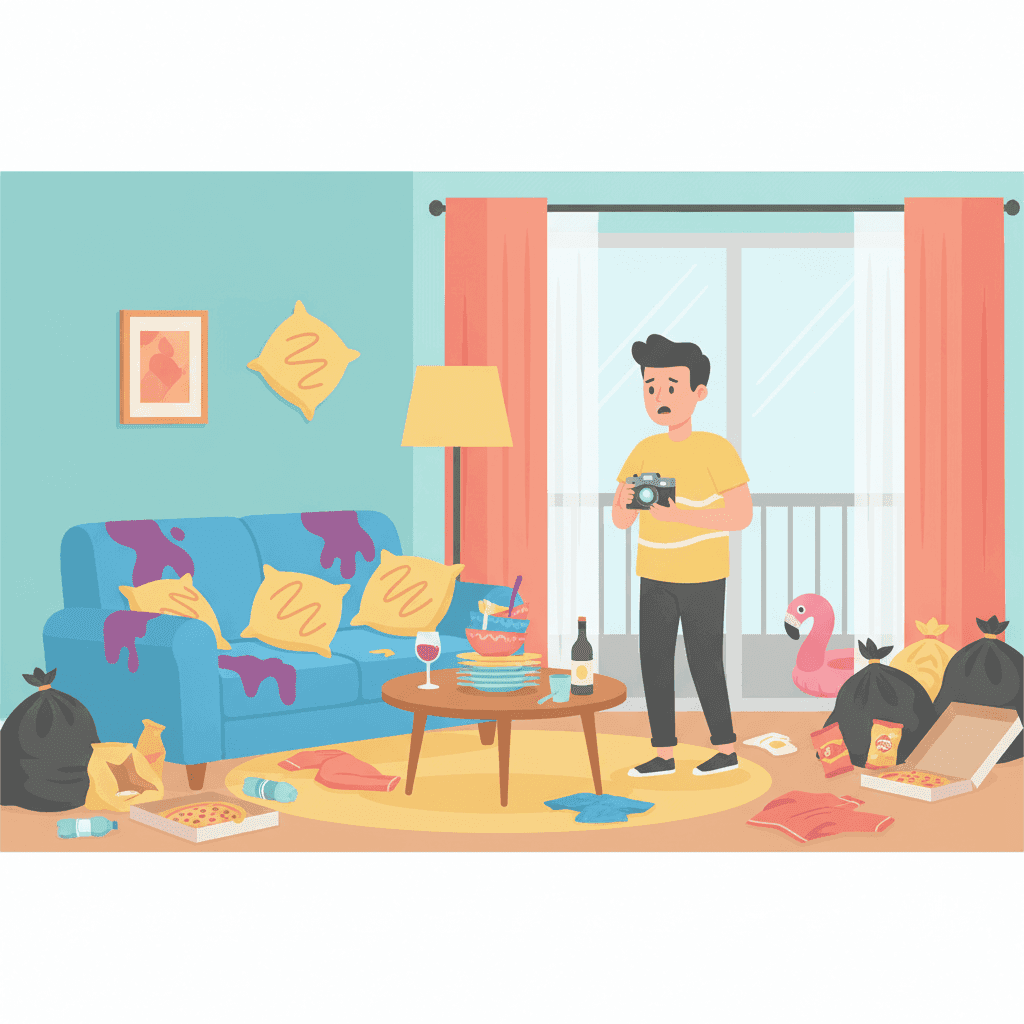
You open the door after check-out and find the living room with wine stains on the sofa, the kitchen with dirty dishes from three days ago, trash not taken out, and a towel used as a doormat. Welcome to the club. In this post, I will tell you step by step what to do when a guest leaves the house a disaster: how to document it, how to charge the extra cost, how to claim from Airbnb or Booking, and how to prevent it from happening again. No drama, with protocol.
What is considered a "disaster" and what is normal use
First of all: not everything that bothers you is claimable. A guest doesn't have to leave the house as if it were a 5-star hotel, but they also can't leave it like a nightclub after closing.
Normal use (not claimable)
- Disheveled beds.
- Used towels on the bathroom floor.
- Trash in the bins (even if not taken out).
- Some dust, crumbs in the kitchen, light stains.
- Used dishes in the sink (if there was no dishwasher or they arrived just in time).
Disaster (claimable)
- Permanent stains on sofas, carpets, mattresses, or sheets.
- Vomit, blood, biological residues.
- Trash accumulated for several days outside the bins.
- Burned grease in the oven or hob.
- Tobacco smell in a non-smoking house.
- Objects broken due to misuse (not wear and tear).
- Extreme dirt requiring extra cleaning hours.
- Parties: cans, bottles, cigarette butts, debris throughout the house.
The key is to distinguish between "standard cleaning included in the rate" and "extra cleaning not needed with a normal guest". Only the latter is charged.
Step 1: document everything before touching anything
This is the number one mistake. You arrive, get angry, start cleaning, and when you want to claim, you have no evidence.
Protocol:
- Photos and videos with date and time. Many, from various angles. Of the whole and of details.
- Compare with previous state. If you have photos from the previous check-in (or inventory), keep them together.
- Keep broken objects. Do not throw them away until the claim is resolved.
- Note timestamps: when you entered, what you found, how long cleaning took.
- Request an invoice for extra cleaning from the cleaning service (with hours breakdown).
If you have documented inventory, this is straightforward. If not, you now know what to do next time.
Step 2: assess the real cost
Do not inflate the bill. Platforms and insurance can sense exaggeration from afar.
| Concept | Approximate Cost |
|---|---|
| Extra cleaning hours | €15-25/hour |
| Washing stained duvet/cover | €15-30 |
| Replacing stained sheets | €30-60 per set |
| Deep cleaning of sofa | €60-150 |
| Mattress cleaning (stains) | €80-200 |
| Eliminating tobacco smell | €150-400 |
| Replacement of broken utensils | per item |
| Post-party disinfection | €200-500 |
Charge the actual cost, with invoices if possible. If you invent figures, you lose credibility and the claim.
Step 3: contact the guest first
Before opening a dispute on the platform, write to the guest. Be polite, with photos, and a specific amount.
Example:
"Hello [name], upon cleaning after your stay, we found [description with attached photos]. Standard cleaning does not cover this, and we had to hire X extra hours + Y for replacement. The total cost is €Z. We would like to charge it through [platform/security deposit]. Do you confirm?"
Many guests pay without arguing. Others negotiate. Some deny everything. Whatever the response, you now have the exchange documented for the dispute.
Step 4: claim through the correct channel
If booked via Airbnb
Use AirCover for hosts. You have 14 days from check-out (or before the next check-in, whichever comes first) to open a claim in the Resolution Center.
You need:
- Clear photos.
- Repair/cleaning invoices or estimates.
- Detailed description.
- Ideally, the prior exchange with the guest.
Airbnb tries to get you to agree. If not, escalate to mediation and let them decide.
If booked via Booking
Booking does not have a damage protection system. You must:
- Charge the security deposit you have retained (if using virtual card or direct charge).
- Or claim from the guest outside (difficult).
That's why many owners charge a separate deposit on Booking. I explain this in detail in deposits and security deposits.
If booked via Vrbo
Has a similar system to Airbnb with host protection. Similar deadlines and process.
If booked directly
Use the security deposit you charged (if you did). If not, bad luck: civil claim, which costs more than the damage.
Step 5: when to activate insurance
For small disasters (less than €500), do not touch the insurance. Deductibles, paperwork, and possible premium increase are not worth it.
For serious disasters (parties with structural damage, thefts, fires), yes. Check what insurance you need to understand what your policy covers.
How to prevent the next disaster
The best management of a disaster is to prevent it. Things that work:
Filter suspicious reservations
- New profiles without reviews: ask for extra verification or reject.
- Local weekend bookings: red flag for parties.
- Young groups responding with monosyllables: bad vibe.
- One-night stays on weekends: prohibit if possible.
Set clear rules in writing
In the listing and in the welcome manual: no parties, no smoking, maximum number of people, penalties for violations.
Collect a security deposit (or use a card as guarantee)
A guest who knows they might be charged €300-€500 behaves differently.
Install noise sensors
They detect parties before the house gets wrecked. I explain how they work in noise sensors.
Leave friendly visible notes
"Please leave dishes in the dishwasher before leaving" works wonders. Most people comply if asked.
Have a check-out checklist
A small list with 5 points: pick up trash, turn off AC, close windows, leave keys, etc. People cooperate if they know what to do. Ideas are in the perfect checkout protocol.
Special cases
Party with serious damages
If neighbors or the noise sensor alert you, act: call, go in person, call the police if needed. Document with time, witnesses, and (if you go yourself) with witnesses too. Airbnb has a strict anti-party policy and usually supports the host.
Theft or intentional damage
Report to Police or Civil Guard. Without a report, no serious insurance claim. Keep a copy of the report.
Stains on mattress that won't come out
Sometimes it’s necessary to replace it. Keep receipts of the old mattress (to show age) and the new one. The platform usually covers residual value, not brand new replacement.
Persistent tobacco smell
Professional ozonation (€150-400), washing all textiles, and sometimes painting. Document with videos showing improvised ashtrays, cigarette butts, etc.
Common mistakes that leave you unpaid
- Cleaning before documenting. Bye-bye evidence.
- Exaggerating the amount. The platform reduces or rejects.
- Claiming late. Airbnb has short deadlines (14 days).
- Not having prior inventory. Hard to prove what was there before.
- Invoices made by yourself. Suspicious. External ones are better.
- Not responding quickly to the guest. If they delay, mediation cools down.
- Accepting any reservation out of fear of gaps. A bad guest costs more than an empty night.
How Autoregistro fits in
This post is about damage management, not traveler registration. But there is a connection: the better you identify each guest (full name, ID, contact), the easier it is to claim if something goes wrong.
Autoregistro handles that: the guest fills out a form with their data and ID, and everything is sent automatically to SES Hospedajes as required by law. You keep the data stored in case you need to claim, report, or report. It costs €1 per month per property (less than a coffee) and saves you the hassle of manual traveler reports.
Frequently Asked Questions
Can I keep the security deposit without informing the guest?
No. You must justify the charge with evidence and notify them. If you do it without warning, the guest can claim and you will probably have to return the money.
How long do I have to claim on Airbnb?
14 days from check-out or before the next check-in, whichever comes first. If you wait longer, you lose the right.
Can I charge extra cleaning if the guest left dishes unwashed?
It depends. If it’s just reasonable disorder, no. If you spend 3 extra hours due to excessive dirt, yes, with justification.
What if the guest denies the damages?
Open a dispute on the platform. With photos, invoices, and message exchanges, the host usually wins. Without evidence, no.
Is it worth claiming €50?
Yes, even just to set a precedent. Also, the guest might receive a warning or a bad review from the platform, which protects other hosts.
Can I leave a negative review for the guest who wrecked my house?
Yes, and you should. It’s the best way to protect the community. Be descriptive and factual: "left the house with damages requiring deep cleaning and textile replacement". Avoid insults.
Related posts

Ready to automate your guest registration?
Create your account and start streamlining SES Hospedajes compliance for your Spanish rentals.
Get started