Swimming Pool in Tourist Accommodation: Regulations, Actual Costs, and How Much It Boosts Your Bookings
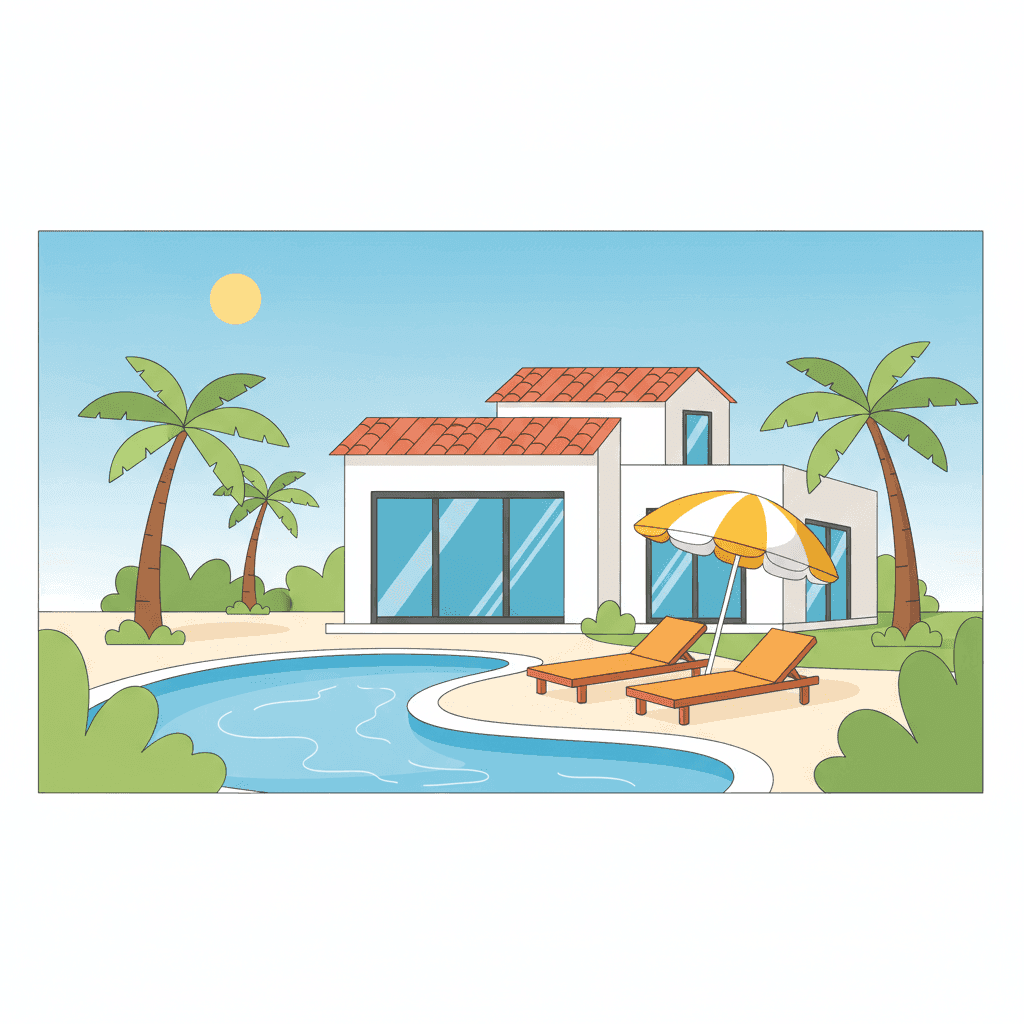
Having a swimming pool in your tourist accommodation can be the key factor that makes you close the summer with 95% occupancy... or a bottomless pit of expenses, fines, and legal scares. In this post, I tell you what no one tells you before listing your apartment or house with a pool: what regulations apply depending on your autonomous community, the real annual maintenance costs, the insurance you need, and whether the investment is worth it considering the numbers.
Let me say upfront: the pool is one of the best upgrades to increase average rate and occupancy in sunny and beach areas or inland with heat. But it’s also where most owners make costly mistakes by not reading the small print.
Is it worth having a pool? The real numbers
Before diving into regulations, let’s get to what matters: how much does it actually increase your bookings?
According to market data in Spain (Airbnb, Booking, local portals), a tourist accommodation with a pool in coastal or warm inland areas can:
- Increase the average rate by between 20% and 40% in high season
- Boost occupancy from June to September by between 15% and 25%
- Double or triple the number of families booking (the group of guests that pays the most)
- Appear in search filters like "with pool," which is often the first thing guests select
In inland areas without extreme heat or in northern coasts, the effect diminishes. A heated pool can make a difference there, but the costs skyrocket.
Quick rule: if your property is in Andalusia, Levante, Balearic Islands, Canary Islands, Extremadura, Murcia, or warm inland areas (Madrid, Toledo, Zaragoza in summer), the pool pays off. In Galicia, Asturias, Cantabria, or the Basque Country, think twice.
Pool regulations in tourist accommodation: what could close your listing
This is where many owners mess up. A pool in tourist accommodation IS NOT the same as a private residential pool. Once you rent it out, you enter a different and stricter regime.
Private use vs collective use pool
Royal Decree 742/2013 regulates collective pools in Spain. Here’s the key distinction:
- Single-family private pool: used only by the owner and their family. Very little regulation.
- Collective use pool: includes hotels, campings, community pools... and here’s where your tourist accommodation might fall depending on the autonomous community.
The problem: each autonomous community interprets this differently. Some consider that if you rent the pool along with the accommodation to different guests each week, it’s a collective use. Others keep it private as long as only the renting group uses it.
Common requirements if your pool is considered collective use
If your autonomous community considers it collective (for example, Balearic Islands or some parts of Catalonia are strict), they typically require:
- Periodic water analysis (chlorine, pH, transparency) with minimum daily frequency in some cases
- Sanitary register book with signed controls
- Perimeter fencing at least 1.2 meters high
- Lifeguard if it exceeds a certain area (usually 200 m²)
- First aid kit, shower, depth signage, emergency phone
- Automatic filtration and chlorination system with proven capacity
In normal tourist accommodations, you rarely reach 200 m² of water surface, so you can skip the lifeguard. But water analysis and the register book are common.
Differences by autonomous community
| Community | Typical regime | Notable requirements |
|---|---|---|
| Andalusia | Collective use if tourist | Weekly analysis, register book |
| Balearic Islands | Strict collective use | Frequent analysis, mandatory fencing |
| Catalonia | Depends on municipality | Check with local authorities |
| Valencia | Collective use if hosting third parties | Minimum biweekly analysis |
| Canary Islands | Collective use | Similar to small hotels |
| Madrid | Collective use | Regional health regulations |
| Murcia | Collective use | Analysis and register book |
For exact details in your area, see tourist rental requirements by autonomous community.
Actual costs of maintaining a tourist pool
This is where many owners get surprised. The pool is not just the initial installation. It’s a significant ongoing expense.
Installation costs (new pool)
- Concrete pool 4x8 m: €15,000 to €30,000 depending on land and finishes
- Prefabricated polyester pool: €8,000 to €15,000
- Removable steel pool with lining: €3,000 to €6,000 (mid-quality)
- Filtration system, pump, stairs, lighting: €1,500 to €3,000 extra
- Certified perimeter fencing: €40 to €80 per linear meter
A decent concrete pool in a tourist house costs around €20,000 to €35,000 turnkey, plus terrace and paving.
Annual maintenance costs
Here are realistic numbers for a 32 m² pool (4x8 m) during normal season (May to September):
| Item | Annual cost |
|---|---|
| Chemicals (chlorine, algaecide, pH) | €200 to €400 |
| Filtration electricity | €300 to €600 |
| Filling and topping up water | €150 to €300 |
| Weekly professional maintenance | €1,200 to €2,400 |
| Sanitary analyses (if applicable) | €200 to €500 |
| Repairs and unforeseen expenses | €300 to €800 |
| Total annual | €2,350 to €5,000 |
If you handle maintenance yourself and don’t hire a company, you save the biggest part. But it’s at least an hour a week, and you need to know what you’re doing.
Heated pool: multiply costs
If you plan to heat the pool to extend the season:
- Heat pump: €2,500 to €5,000 installation
- Thermal cover: €500 to €1,500
- Extra electricity consumption: €100 to €300 per month in operation
It’s only worth it if you rent a lot outside high season.
Insurance: normal home insurance is not enough
A critical point many ignore. Your personal home insurance does not cover guest accidents in the pool if you rent out the property. You need a specific tourist accommodation insurance with extended liability.
Minimum coverages you should demand:
- Civil liability of at least €300,000 (better €600,000)
- Specific coverage for pool and wet area accidents
- Third-party damages from slips, drownings, cuts from tiles
- Legal defense
The extra cost to add a pool to your insurance is usually between €80 and €200 per year. It’s a small price compared to the potential scare. More details at what insurance do you need for your tourist rental in Spain.
A drowning or serious accident without insurance can ruin you. Literally. Compensation amounts of €200,000 to €500,000 are common in Spanish rulings.
Guest usage rules: what to include in the welcome manual
The pool is where most problems happen: noise, accidents, neighbor complaints, parties... Set clear rules from the start.
In your welcome manual, always include:
- Usage hours: usually 9:00 to 22:00 (or as per your homeowners’ association)
- No minors swimming alone without responsible adult
- No glass in the pool area (to prevent cuts)
- Shower before entering the water
- No head-first diving if the pool is shallow
- No parties or loud music after 22:00
- Visible emergency phone (112)
Also, put a laminated sign near the pool in Spanish and English at minimum.
Pool in a building with shared amenities: the trickiest chapter
If your tourist accommodation is in a building with a shared pool, be prepared. Many communities are banning or restricting the use of pools for tourist guests.
Possible scenarios:
- The homeowners’ association approves banning access to tourist guests (legally if approved by the required majority)
- They require a special fee for intensive use
- They impose restricted hours or limit capacity
Check your community’s statutes before advertising "pool included." If they later ban it, you’ll have a problem with your guests. More on this in can they prohibit me from renting my tourist apartment in my building.
Common mistakes I see repeatedly
- Advertising "heated pool" when it only has a thermal cover. Deceptive and sure to get a 1-star review.
- Not fencing the pool in family homes. A child falls, and you’re in jail. No exaggeration.
- Not analyzing water or keeping a register. Inspection arrives and they shut down your activity.
- Skipping professional maintenance. Green water in August is a killer review.
- Not informing about maintenance closures in the booking. If the pool is out of service when guests arrive, you’re probably entitled to a partial refund.
- Cheap removable pool in a small garden. Looks tacky in photos and adds no value.
How Autoregistro fits in
If you have a pool, you probably also have higher guest turnover in summer. And more guests mean more traveler IDs to send to SES Hospedajes, more DNIs to manage, and more paperwork that takes time away from cleaning the filter.
Autoregistro costs €1 per month per property (less than a coffee). Your guests fill out an online form before arrival, and the data is automatically sent to SES Hospedajes. You do nothing. If you already have enough on your plate analyzing water pH, let the registration paperwork run on autopilot.
Frequently Asked Questions
Do I need to hire a lifeguard for my tourist accommodation pool?
Only if the water surface exceeds 200 m² in most autonomous communities. A typical tourist accommodation pool (4x8, 5x10) is well below that, so no. But you do need signage, a first aid kit, and a visible emergency phone.
Can I fill the pool with water from my well or tank?
Yes, as long as it meets potability and quality standards. If the water isn’t from the municipal supply, some communities require more frequent analyses. Be aware of drought restrictions: in recent years, filling pools has been prohibited in some parts of Catalonia and Andalusia.
Is fencing the pool mandatory?
It depends on the autonomous community and municipality. Andalusia and Balearic Islands usually require a perimeter fence of at least 1.2 meters for collective pools. For family tourist homes (with children), fencing is highly recommended even if not mandatory, for safety and insurance reasons.
Can I charge extra for pool use?
You can, but it’s uncommon and usually poorly received. It’s best to include the pool in the reservation price and increase the base rate. Charging separately gives a stingy image and deters bookings.
What if the pool breaks during a reservation?
Notify the guest as soon as you know, offer proportional compensation (10-20% of the reservation is common if the pool was a key factor), and fix it ASAP. Document everything in writing. If you don’t compensate, reviews will be brutal, and platforms like Airbnb or Booking will likely require refunds anyway.
Ready to automate your guest registration?
Create your account and start streamlining SES Hospedajes compliance for your Spanish rentals.
Get started