Inventory of Your Tourist Accommodation: How to Do It Right and Why It Saves You Money Every Month
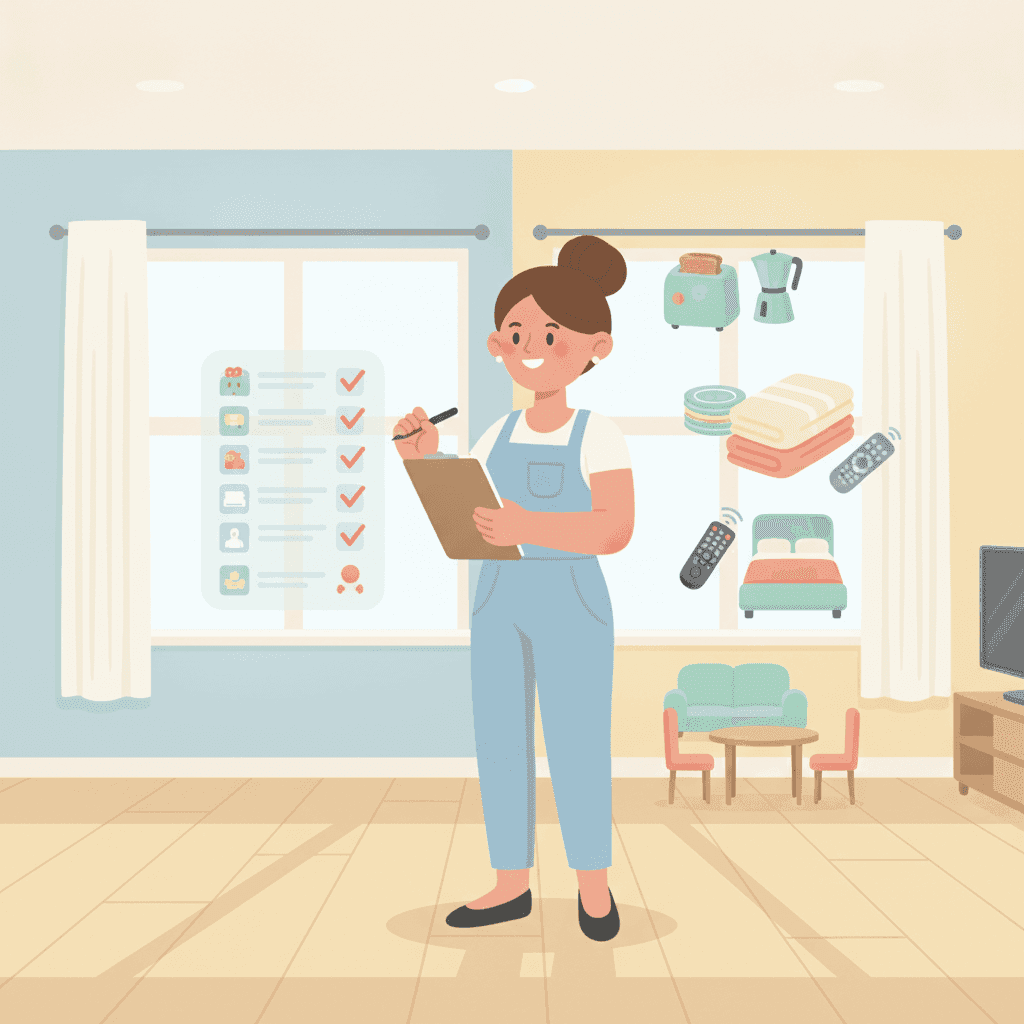
Having a detailed inventory of your tourist accommodation saves you hassle, theft, and hours of work. I'll tell you how to set it up, what to include, and how to keep it updated without going crazy. With examples, mental templates, and the common mistakes I see owners making after years in this business.
Why You Need an Inventory (Even If You Think You Don’t)
Many owners tell me: "I know what I have in my apartment, I don't need a list." Okay, until a guest takes 3 towels, the cleaner says 6 glasses are missing, and you don't know if it's true or if there were never 6 glasses.
A well-made inventory helps you to:
- Claim damages or thefts from the guest with evidence. Without an inventory, no claim is possible.
- Coordinate with the cleaner: know what should be in each closet and be alerted if something is missing.
- Replenish without thinking: instead of checking what’s missing each week, you have a fixed list.
- Transfer management: if you hire someone or sell the property one day, everything is documented.
- Deduct expenses: every purchase you make for the apartment is a deductible expense. If you keep a record, the tax authorities will find it easy.
And most importantly: it prevents that horrible feeling of "I think something was missing but I don't know what".
What Should a Complete Inventory Include
It's not just about counting spoons. A decent inventory has several layers.
Furniture and Major Appliances
Everything that doesn't move or would cost a fortune to replace:
- Sofas, armchairs, tables, chairs
- Beds, mattresses, bed bases
- Wardrobes, dressers, shelves
- Refrigerator, washing machine, oven, microwave, vitroceramic
- TV, router, air conditioning, heater
For each, note: brand, model, purchase date, price, serial number (if applicable), and saved invoice. This is gold when dealing with warranties or insurance.
Kitchenware
This is where most things go missing. Be specific:
| Category | Recommended Quantity (4 pax apartment) |
|---|---|
| Flat plates | 6-8 |
| Deep plates | 6-8 |
| Dessert plates | 6-8 |
| Water glasses | 6-8 |
| Wine glasses | 6-8 |
| Coffee cups | 6-8 |
| Cutlery set | 6-8 |
| Pans | 2 (one large, one small) |
| Pots | 2-3 |
| Kitchen knives | 3-4 |
If you want to go deeper, I have a detailed post about kitchenware in tourist accommodation and another about dinnerware and glassware.
Bedding and Towels
The basic rule is to have 3 sets per bed: one in use, one being washed, one as a spare. The same applies to towels.
Note exact quantities of:
- Fitted sheets (by bed size)
- Duvet covers / duvet covers
- Pillowcases
- Pillows
- Duvets and blankets
- Hand towels, shower towels, bidet towels
- Bath mats
More details in the post about bedding in tourist accommodation.
Decoration and Small Objects
This is what people forget and then are surprised when they disappear:
- Paintings, prints, mirrors
- Decorative cushions
- Table lamps
- Plants (real or artificial)
- Rugs
- Ornaments and vases
Technical Equipment and Accessories
- Remote controls (TV, air conditioning, garage)
- HDMI cables, chargers
- Hairdryer
- Iron and ironing board
- Vacuum cleaner or robot
- Coffee maker and accessories
- Bathroom scale
Documentation and Instructions
- Welcome manual
- Appliance instructions
- Emergency numbers
- WiFi (name and password visible)
How to Set Up the Inventory Step by Step
1. Walk through the house room by room
Using your phone and a spreadsheet (Google Sheets works perfectly). Don’t try to remember everything from the sofa. Go closet by closet, drawer by drawer.
2. Take photos of everything
Make general photos of each room and specific photos of:
- Open kitchen drawers
- Inside closets
- Shelves
- Furniture with visible brand marks
These photos are your proof if a guest takes something or breaks something.
3. Number the units
Don’t write "several glasses". Write "8 water glasses". Precision is what allows you to claim later.
4. Add replacement value
Next to each item, note how much it would cost to replace today. This helps you to:
- Calculate realistic deposits
- Claim damages with concrete numbers
- Know the actual value of your property’s contents (for insurance)
5. Save invoices
Create a folder in Google Drive with all purchase receipts. If you have an inspection, a claim, or a tax review, you'll be glad to have it.
Important notice: to deduct expenses on your income tax, you need an invoice in your name (or the activity holder’s). Simplified tickets are not valid. More info in the post about deductible expenses.
How to Keep It Updated Without Going Crazy
The inventory is not a one-time document to create and forget. It’s a living document.
Monthly review with the cleaner
Every month (or every 4-5 stays, whichever comes first), the person who cleans does a quick review and notes what’s missing. You give them a simplified checklist, and they return a list of replenishments.
Replenishment record
Every time you buy something for the apartment, note: what, when, how much it cost. This serves two purposes: to know what breaks/disappears most (and act accordingly) and to keep expenses organized for tax declaration.
Full review every 6 months
Twice a year, a thorough review. Take everything out, count, compare with the original inventory, and update.
How to Use the Inventory to Claim Damages
Here’s the key: if a guest breaks something or takes something, how do you prove it?
- Photo of the inventory before check-in (or a general inventory with date)
- Photo of the state after check-out
- Invoice or replacement value of the item
- Written communication with the guest (through the reservation platform)
With this, both Airbnb and Booking usually side with the host if the claim is reasonable. Without it, forget it.
More about this in the post on damages and deposits.
Common Mistakes I See Constantly
Overly Generic Inventory
"Complete kitchen" is not enough. You need exact quantities.
Not Updating After Purchases
Buy a new coffee maker and don’t add it. After a month, you don’t know if it was stolen or never registered.
Not Sharing It with the Cleaner
They see the most things daily. If they don’t have access to the inventory, you’re losing their help.
Not Including Consumables
Salt, oil, toilet paper, dishwasher tablets... are also part of the inventory, even if replenished constantly. It helps you calculate how much you spend monthly.
Only Keeping It on Paper
If it’s only in a notebook in the apartment, one day it disappears. Digital and cloud-based is always better.
Basic Template to Start Today
Open a Google Sheets with these columns:
| Room | Category | Item | Quantity | Brand/Model | Purchase Price | Purchase Date | Replacement Value | Notes |
Start with the kitchen (where most items are) and keep going. In an afternoon, you’ll have 80% done.
How Autoregistro Fits In
Having your operation organized starts with the basics: knowing what you have in the apartment and who is there at each moment.
At Autoregistro, we take care of the second part. Your guests fill out an online form with their data, and we automatically send it to SES Hospedajes. No fuss, no manual data entry, no rejected reports at 11 pm.
It costs 1 euro per month per property. Less than a coffee. And it takes one of the heaviest tasks out of your daily management, so you have time to keep your inventory up to date and handle everything else.
Frequently Asked Questions
Is it mandatory by law to have an inventory?
There is no national law requiring a detailed inventory. But regional regulations do require the property to be equipped with what’s necessary for guests. Having an inventory is more about management and self-protection than a legal obligation.
Should I show the inventory to the guest upon arrival?
It’s not necessary to show the entire inventory, but it’s good practice to leave a visible copy of the welcome manual with the basics. If a dispute arises over damages, being able to show the inventory helps a lot.
How often should I review the inventory thoroughly?
I recommend a quick monthly review (with the cleaner) and a full review every 6 months. During high season, every 3-4 months is better.
What if a guest takes something?
Document with photos before/after, calculate the replacement value, contact the guest through the reservation platform (Airbnb, Booking), and open a claim with evidence. Without a prior inventory, the platform almost never sides with you.
Can I deduct the inventory as an expense?
Yes, everything you buy for the property’s equipment is deductible in your income tax if you have an invoice in your name. Durable objects (furniture, appliances) are amortized over several years; consumables are fully deductible in the year.
Related posts
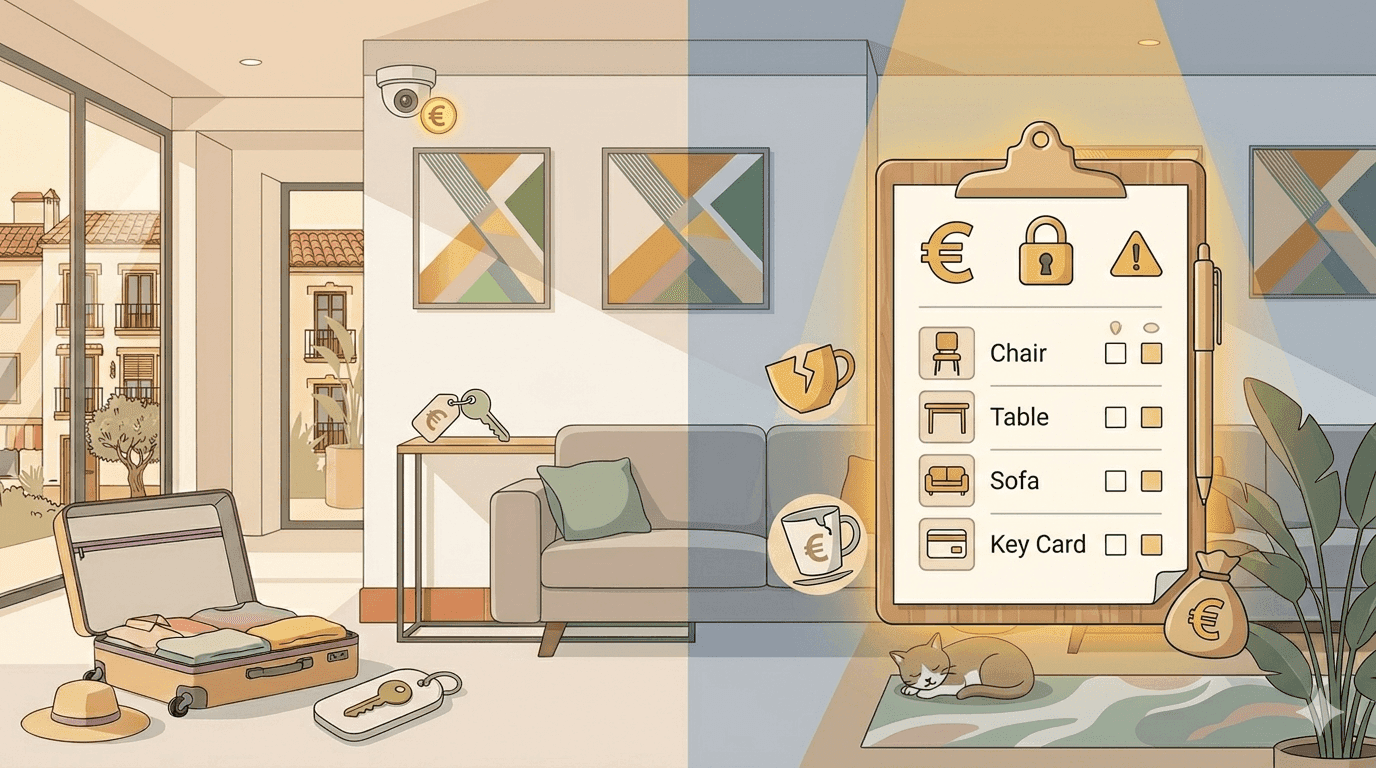
How to manage guest damage and security deposits in your vacation rental
Practical guide to preventing, documenting, and resolving guest damage in your vacation rental: security deposits, platform protection, insurance, and a step-by-step claims process.

Kitchenware in Vacation Rental Homes: What to Include, What to Avoid, and How Much It Really Costs
Practical guide to equip your vacation rental kitchen without overspending or falling short. Lists, real prices, and common mistakes that cost you reviews.
Ready to automate your guest registration?
Create your account and start streamlining SES Hospedajes compliance for your Spanish rentals.
Get started