How to manage guest damage and security deposits in your vacation rental
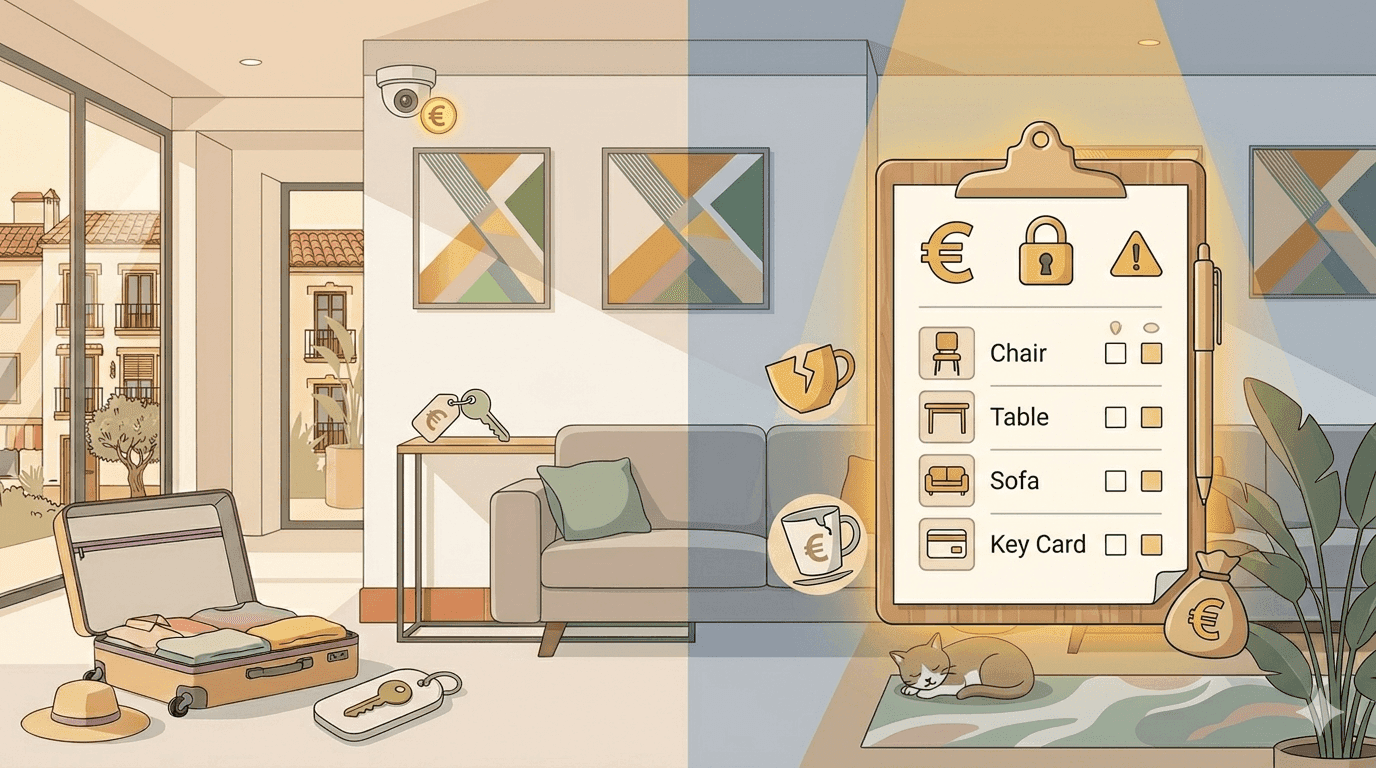
Guest damage is inevitable in vacation rental — the question is how to minimize it and how to recover costs when it happens. The main tools are the security deposit, platform protection, content insurance, and a rigorous documentation process. This guide covers how to set up each layer and what to do step by step when a guest causes damage.
If you rent your property to tourists, sooner or later a guest will break something. It might be a glass, it might be a door, it might be the entire sofa. Most damage is minor and accidental. Some is serious. And a few cases are intentional.
What separates an owner who absorbs losses from one who recovers them isn't luck — it's having a system. Documentation before and after each stay, a well-configured deposit, knowledge of platform protections, and insurance that covers what the deposit doesn't reach.
This guide gives you that complete system.
Prevention: the first line of defense
Before talking about deposits and claims, let's talk about reducing the probability of damage occurring.
Durable equipment
- Sturdy furniture: avoid fragile or delicate design pieces. Opt for resistant materials (solid wood, metal, washable fabrics). Mid-to-high range IKEA furniture has a good durability/price ratio for vacation rental.
- Washable textiles: removable sofa covers, waterproof mattress protectors, medium-quality towels (high-end ones stain just as easily and cost more to replace).
- Robust appliances: reliable brands, simple models. A guest isn't going to read a 40-page manual.
- Spare kitchenware: keep stock of glasses, plates, and cutlery. It's cheaper to replace than to claim.
Clear instructions
Many damages occur from ignorance, not bad intentions:
- How to use the ceramic hob without scratching it
- How the toilet flush works (if it has any quirks)
- What not to put in the dishwasher
- How to open and close blinds without forcing them
- Rules about smoking inside the property
A brief document with basic instructions, sent before arrival and available in the property, prevents more damage than any deposit.
Realistic capacity
More guests means more probability of damage. Don't list your 60 m² apartment for 8 people. Adjust capacity to what's reasonable and your furniture will thank you.
The security deposit
What it is
The deposit is an amount the guest pays before the stay that's returned at the end if there's no damage. If there is, you retain the portion corresponding to the repair or replacement cost.
How much to charge
There's no fixed rule, but the typical range is:
| Property type | Typical deposit |
|---|---|
| Standard apartment | €150 – €300 |
| High-end property | €300 – €500 |
| Villa with pool | €500 – €1,000 |
| Luxury property | €1,000 – €2,000 |
The deposit should be proportional to the value of content at risk. Too high discourages bookings; too low doesn't cover a broken window.
How to manage it by platform
Airbnb:
- Airbnb doesn't manage traditional deposits. Instead, it offers AirCover for Hosts, covering up to $3,000,000 in damage.
- You can request a "security deposit" when creating the listing, but Airbnb doesn't charge the guest upfront — it only holds an authorization and charges if you file a claim.
- Claim deadline: 14 days after check-out or before the next guest's check-in (whichever comes first).
Booking.com:
- Booking allows configuring a damage deposit that's charged or pre-authorized to the guest.
- You can choose between upfront charge or card pre-authorization.
- Claim management is between you and the guest — Booking doesn't mediate directly.
Vrbo:
- Allows configuring a refundable security deposit.
- Charged to the guest at booking time.
- Vrbo mediates in disputes if there's no agreement.
Direct booking (own website):
- You have full control. You can charge the deposit by transfer, card, or payment gateway.
- Recommendation: use a card pre-authorization instead of an actual charge. It's less friction for the guest and easier to return.
Legal framework for deposits
In Spain, the deposit in vacation rental isn't regulated as strictly as in long-term residential rental (where the LAU limits the deposit to one month's rent). In vacation rental, you can set whatever amount you consider reasonable, as long as it's clearly communicated before booking.
Some autonomous communities have specific regulations on deposits in tourist accommodations. Check your territory's rules.
Documentation: the key to successful claims
Without documentation, there's no claim. It's that simple. If you can't prove the prior condition of the property, the platform or insurer will deny your claim.
Before each stay
- Photos of the property's condition: all rooms, appliances, furniture, walls, floors. Pay special attention to risk areas (kitchen countertop, sofa, bathroom).
- Updated inventory: list of all items with their condition. Doesn't need to be exhaustive — focus on valuable items.
- Date and time: photos should have date metadata or you can include a newspaper/screen with the visible date.
After each stay
- Inspection before returning the deposit: check the property as soon as possible after check-out. If you delegate cleaning, ask the cleaning team to report any damage before cleaning.
- Photos of damage: if you find something, document it immediately with photos and video.
- Repair estimate: get a quote or invoice for the repair/replacement cost.
Practical tip
Create a digital folder per stay (guest name + dates) where you store before photos, after photos, and any relevant communication. If you use a cleaning service, ask them to send you photos of the condition when they arrive.
What to do when there's damage: step by step
1. Document immediately
Photos, video, written description of the damage. The sooner, the better. Don't clean or repair anything before documenting.
2. Contact the guest
Communicate the damage to the guest professionally and objectively. Send photos and describe the problem. Many guests acknowledge the damage and agree to pay without conflict.
Example message:
"Hi [name], after your stay we've found [description of damage]. Photos attached. The repair/replacement cost is €[amount]. We'll proceed to deduct this amount from the deposit. If you have any questions, I'm available to discuss."
3. Claim through the platform
If the guest doesn't respond or doesn't accept, use the platform's resolution system:
- Airbnb: Resolution Center → request money from guest → attach evidence. If no agreement in 72h, Airbnb mediates.
- Booking: contact the guest directly. If no response, contact Booking support with documentation.
- Vrbo: open a damage claim with photos and estimate.
4. Fall back to insurance if deposit/platform doesn't cover it
If the damage exceeds the deposit and the platform doesn't cover it (or you don't use a platform), file a claim with your content insurance. You'll need:
- Photos of prior condition and damage
- Repair estimate or invoice
- Booking and guest details
- Copy of communication with the guest
5. Repair and replace
Don't let damage affect subsequent guests. Repair as soon as possible and update your inventory and reference photos.
Common damage and how to handle it
| Damage | Frequency | Typical cost | Who pays |
|---|---|---|---|
| Textile stains (sofa, mattress) | Very high | €50 – €200 | Deposit |
| Broken kitchenware (glasses, plates) | High | €10 – €30 | Absorb as operating cost |
| Countertop burns | Medium | €100 – €500 | Deposit + insurance if exceeds |
| Appliance damage | Medium | €100 – €800 | Deposit + insurance |
| Wall damage (holes, marks) | Medium-low | €50 – €300 | Deposit |
| Furniture breakage | Low | €100 – €1,000 | Deposit + insurance |
| Structural damage (doors, windows) | Very low | €200 – €2,000 | Insurance |
| Theft | Very low | Variable | Insurance + police report |
Practical rule: damage under €30-50 isn't worth the claim time. Include it as an operating cost in your annual budget. Focus on documenting and claiming significant damage.
Platform protection: what they actually cover
Airbnb AirCover for Hosts
- Coverage up to $3,000,000 for property damage
- Includes: property damage, furniture, valuables, deep cleaning
- Excludes: normal wear, pre-existing damage, cash, pets (unless allowed), vehicles
- Process: must claim within 14 days and provide evidence
- Reality: claims under $200-300 usually resolve quickly. Larger ones can take weeks and require extensive documentation.
Booking.com
- No protection program equivalent to AirCover
- Damage management is between owner and guest
- The damage deposit is your main tool
Vrbo
- Offers an optional damage protection plan
- Coverage up to $5,000 per booking
- Claims process similar to Airbnb
Bottom line: platform protections are a complement, not a substitute for your own insurance. Use them as the first line of claims, but have insurance for what they don't cover.
How Autoregistro fits in
When a guest causes damage, you need to know exactly who was in your property, when, and with what details. Autoregistro maintains a complete record of each stay: guest data, verified identity documents, exact check-in and check-out dates.
That information is essential for:
- Identifying the responsible guest without ambiguity
- Providing verified data in a claim to the platform or insurer
- Demonstrating the stay chronology in case of dispute
- Complying with mandatory guest registration, which also protects you legally by having the guest's data documented
It doesn't prevent damage, but it gives you the documentary foundation to claim it successfully.
Related posts
10 mistakes new vacation rental owners make in Spain (and how to avoid them)
The most common mistakes made by new vacation rental owners in Spain: from operating without a license to ignoring guest registration, plus fines, neighbor conflicts, and inspections. A practical guide to not tripping up.

How to improve your vacation rental listing and get more bookings
A practical, in-depth guide to optimizing every aspect of your listing — photos, title, description, pricing, reviews, and more — to turn views into actual reservations.
What insurance do you need for your vacation rental in Spain?
Complete guide to mandatory and recommended insurance for tourist-use properties in Spain: civil liability, home, non-payment, legal protection, and specific coverages you should demand.
Ready to automate your guest registration?
Create your account and start streamlining SES Hospedajes compliance for your Spanish rentals.
Get started