10 mistakes new vacation rental owners make in Spain (and how to avoid them)
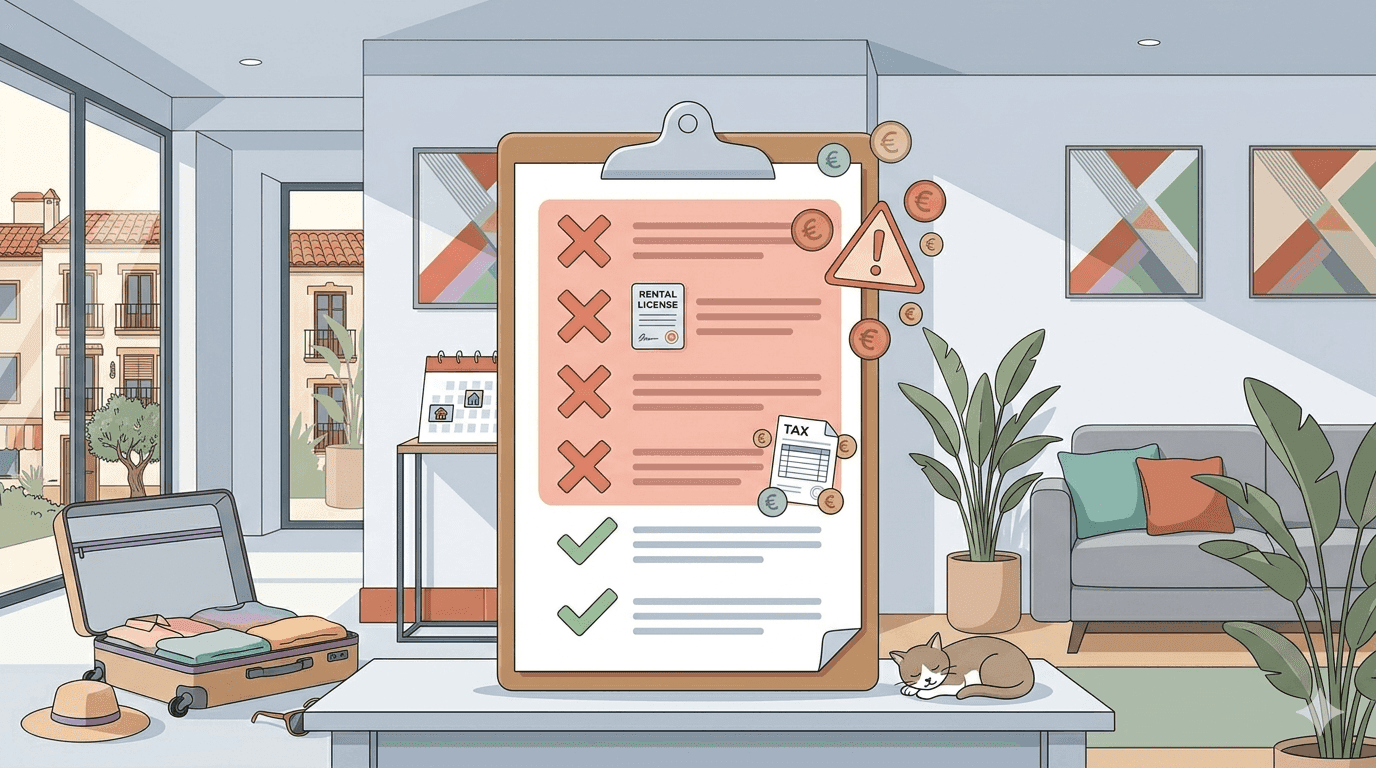
New vacation rental owners in Spain make predictable mistakes: operating without a license, not registering guests, ignoring taxes, neglecting the homeowners' association, or lacking liability insurance. Some of these mistakes carry fines of up to €600,000. This guide covers the 10 most common ones and how to avoid each.
Getting started with vacation rental in Spain is easier than ever. Listing on Airbnb takes 20 minutes. Getting your first booking, a few days. Getting your first fine, also a few days.
The problem isn't that information doesn't exist — it's that there's so much of it that many owners jump in without the full picture. And mistakes in this sector aren't minor: we're talking administrative penalties, tax problems, legal conflicts with neighbors, and in the worst cases, forced closure of the activity.
This guide covers the 10 most frequent mistakes we see from owners who are starting out. They're not theoretical — they're the ones that generate real problems, repeatedly. If you're just starting or haven't been at it long, review them one by one. If you've been doing this for years, you might discover one you've overlooked.
Mistake 1: Operating without a license or responsible declaration
It's the most basic mistake and the most expensive. Many owners assume that simply listing on a platform is enough to start renting legally. It's not.
What the law requires
In every autonomous community in Spain, you need to file a responsible declaration (or, in some cases, obtain a license) with the regional tourism registry before operating. This process gives you a tourism registration number that must appear on all your listings.
Additionally, since July 2025, you need a national registration number under RD 1312/2024. Without it, platforms can block your listing.
What happens if you don't
Penalties vary by autonomous community, but the typical range is:
- Minor infraction: €600 – €6,000
- Serious infraction: €6,001 – €60,000
- Very serious infraction: €60,001 – €600,000
Operating without a license is usually classified as a serious infraction. In communities like the Balearic Islands or Catalonia, fines for operating without registration have exceeded €40,000 in real cases.
How to avoid it
Before publishing a single listing, complete the registration process. We have a step-by-step guide to registering your tourist property covering the entire process, and a guide to requirements by autonomous community so you know exactly what your territory demands.
Mistake 2: Not registering guests with SES Hospedajes
This is the second most common mistake and one of the most dangerous, because the obligation comes from the Ministry of the Interior, not tourism. It's not a minor bureaucratic formality — it's a national security obligation.
What the law requires
Royal Decree 933/2021 requires all accommodations in Spain to report each guest's data to the SES Hospedajes system (or the corresponding police system in Catalonia and the Basque Country) within 24 hours of check-in.
Required data includes: full name, date of birth, nationality, sex, identity document, address, and booking details.
What happens if you don't
Penalties for non-compliance with guest registration are separate from tourism penalties:
- Minor infraction: €100 – €600
- Serious infraction: €601 – €30,000
- Very serious infraction: €30,001 – €600,000
Additionally, repeated non-compliance can lead to closure of the establishment and criminal liability if linked to criminal activities.
How to avoid it
Register with SES Hospedajes as part of your property registration process. Don't leave it for later. And establish a reliable system for collecting and submitting each guest's data — manual or automated, but one that works without fail. Check our guide on mandatory guest registration for details.
Mistake 3: Not declaring income to the tax authority
"If I collect in cash, the tax authority won't find out." False. "If it's just a few thousand euros, nothing will happen." Also false.
Why the tax authority knows what you earn
Vacation rental platforms are required to file Form 179, an annual informative return reporting all income generated by each host. The tax authority cross-references this information with your income tax return. If there's a discrepancy, an automatic alert is triggered.
Additionally, the European DAC7 directive (in force since 2023) requires platforms to report their users' income to the tax authorities of each member state.
What happens if you don't declare
- Surcharge of 5% to 20% on the unpaid tax (depending on the delay)
- Late-payment interest (currently around 4.0625% annually)
- Additional penalty of 50% to 150% of the defrauded amount if the tax authority initiates a sanctioning procedure
- If the defrauded amount exceeds €120,000, it may constitute tax fraud (criminal offense)
How to avoid it
Declare all income on your tax return. Deduct all expenses the law allows — and there are many. The actual effective rate, after deductions, is usually much lower than people fear. Check our vacation rental tax guide to understand exactly what to declare and what to deduct.
Mistake 4: Ignoring the homeowners' association
You have the license, the registration, everything in order with the administration. But you haven't checked your homeowners' association bylaws. And it turns out there's an agreement prohibiting tourist use in the building.
The legal framework
Since the reform of the Horizontal Property Law in 2019, a three-fifths majority of owners can approve the limitation or prohibition of vacation rental in the building. This agreement is registered with the Property Registry and is binding on all owners, including future buyers.
What happens if you ignore it
The association can sue you and a judge can order the cessation of the activity. Additionally, you may be ordered to compensate the association for damages caused. Legal proceedings are slow but rulings are final.
How to avoid it
Before starting any administrative process, review your community's bylaws and the minutes of recent meetings. If there's no express prohibition, you're in principle authorized, but maintain a good relationship with neighbors. Neighbor conflicts are one of the main causes of complaints and subsequent restrictions.
For more detail, check our article on whether your community can ban vacation rental.
Mistake 5: Not having liability insurance
Standard home insurance doesn't cover vacation rental activity. If a guest is injured in your property, if a fire occurs during a stay, if damage to your property affects a neighbor — without specific liability insurance, you're personally liable with your own assets.
What the law requires
All autonomous communities require civil liability insurance for tourist-use properties. The standard minimum coverage is €150,000, though some communities require more.
What happens if you don't have it
- Administrative penalty for non-compliance with requirements (varies by community)
- Unlimited personal liability for damages to third parties
- Possible revocation of tourism registration
How to avoid it
Take out insurance that expressly covers vacation rental activity. It can be a standalone policy or an extension of your home insurance, but make sure the coverage includes:
- Civil liability toward guests and third parties
- Content damage (furniture, appliances)
- Theft
- Loss of income due to a claim
Approximate cost: €150 – €400 annually. It's one of the cheapest business expenses and one of the most important.
Mistake 6: Applying the 60% reduction on your tax return
This mistake is purely fiscal but surprisingly frequent. The IRPF law allows a 60% reduction on net positive income from property rentals — but only when the tenant uses it as their primary residence.
Why it doesn't apply to vacation rental
Vacation rental involves short stays with rotating guests. No guest uses your property as their primary residence. Therefore, the 60% reduction doesn't apply. You pay tax on 100% of net income.
What happens if you apply it
If the tax authority detects the improper application (and they detect it, because they cross-reference Form 179 data with your return), they'll demand the unpaid tax plus late-payment interest and a penalty that can reach 150% of the difference.
How to avoid it
Simply don't apply it. If your tax advisor suggests it, make sure they understand it's vacation rental, not primary residence rental. To understand the full tax picture, review our tax guide.
Mistake 7: Not keeping signed guest reports
You send the data to SES Hospedajes and forget about it. But regulations require you to keep signed guest reports for a minimum period — and in an inspection, they'll ask for them.
What the law requires
You must keep signed guest reports for at least 3 years. This includes guest data, stay dates, and the traveler's signature (physical or digital).
What happens if you don't keep them
In an inspection, the absence of signed reports is considered non-compliance with guest registration, carrying the same penalties as not having submitted them. It's not enough to have sent them to SES — you need to be able to prove you collected them correctly.
How to avoid it
Establish a filing system from day one. It can be digital (more practical and secure) or physical, but it must be accessible and organized. For more detail, check our guide on keeping signed guest reports.
Mistake 8: Setting prices without a strategy
Many new owners set a nightly price and leave it there all year. Or they copy the neighbor's price without analyzing their own situation. The result: they lose money in high season (price too low) and get no bookings in low season (price too high).
Why it matters
Vacation rental has marked seasonality. Demand varies by month, day of the week, local events, holidays, and competition. A static price ignores all of this.
The real impact
The difference between static and dynamic pricing can be 15-30% in annual revenue. For an apartment generating €20,000 gross per year, that's €3,000-€6,000 in difference.
How to avoid it
- Research your market: analyze prices of similar properties in your area across different times of year. Airbnb and Booking show competitor prices.
- Differentiate seasons: at minimum, have a price for high season, mid-season, and low season. Also adjust weekends vs weekdays.
- Use dynamic pricing tools: services like PriceLabs, Beyond Pricing, or Wheelhouse analyze demand in real time and adjust your prices automatically.
- Review monthly: even if you use automatic tools, review results each month and adjust parameters if needed.
- Don't compete on price alone: a well-equipped property with good photos and positive reviews can charge 20-30% more than a comparable but neglected one. Check our guide to improving your listing.
Mistake 9: Neglecting the relationship with neighbors
Vacation rental generates neighbor friction. Guests who make noise, who don't respect building rules, who use the elevator with suitcases at 3 AM. Even though you're not present, you're responsible for your guests' behavior.
Why it matters more than you think
Neighbor conflicts are the main reason homeowners' associations vote to restrict vacation rental. A single owner who neglects coexistence can trigger a ban affecting the entire building.
Additionally, neighbors can report to the city council, which can lead to inspections and penalties if you're not meeting some requirement.
How to avoid it
- Set clear rules for guests: quiet hours, use of common areas, waste management. Send them before arrival and leave them visible in the property.
- Provide an emergency contact: neighbors should be able to reach you (or your manager) if there's a problem. Leave your number on the mailbox or communicate it to the community president.
- Act fast on incidents: if a neighbor reports a problem, resolve it immediately. Speed of response makes the difference between an annoyed neighbor and one who files a complaint.
- Limit actual capacity: don't list your 2-bedroom apartment for 8 people. More guests = more noise = more problems.
- Soundproof if possible: a basic investment in acoustic insulation (doors, windows, floors) can save you many conflicts.
- Communicate proactively: inform the community that you rent, that you comply with regulations, and that you're available to resolve any issue. Transparency builds trust.
Mistake 10: Managing everything manually without a system
With one property and a few bookings per month, manual management works. But as soon as the activity grows — more bookings, more guests, more platforms, more obligations — chaos sets in quickly.
The symptoms
- You forget to send a guest report to SES Hospedajes
- You can't find the cleaning invoice from 3 months ago
- Double booking because you didn't sync calendars
- You don't know how many days you've rented this year (and you need it for your tax return)
- A guest arrives and doesn't have check-in instructions
- You lose a positive review because you were slow to respond
The real cost
Every manual error has a cost: a fine for an unsent report, a lost booking from double booking, hours reconstructing data for the tax return, a bad review that drops your ranking.
How to avoid it
Systematize from the start, even if you have just one property:
- Channel manager: sync calendars and prices across platforms (Airbnb, Booking, Vrbo, own website). Prevents double bookings.
- Automated messaging: set up automatic messages for confirmation, check-in instructions, reminders, and review requests.
- Automated guest registration: use a tool that collects guest data, validates documents, and sends reports to SES Hospedajes without manual intervention.
- Basic accounting: keep a record of income and expenses from day one. A spreadsheet works at first; accounting software is better in the medium term.
- Digital filing: store invoices, signed reports, contracts, and communications in an organized, accessible system.
You don't need to invest thousands in software from day one. But you do need a system — even a basic one — that prevents things from falling through the cracks.
Inspections: what to expect
Many new owners believe inspections are rare or nonexistent. They're not — and the trend is toward more oversight, not less.
Who inspects
- Regional tourism inspection: verifies you meet your autonomous community's requirements (license, equipment, signage, insurance, complaint forms).
- Police / Guardia Civil: verifies compliance with guest registration (SES Hospedajes).
- Tax authority (AEAT): verifies you're declaring income correctly. Can request documentation for the last 4 years.
- City council: verifies compliance with municipal regulations (zoning, activity license, noise).
What they typically ask for
- Tourism registration number and supporting documentation
- National registration number
- Valid civil liability insurance
- Complaint forms
- Signed guest reports from the last 3 years
- Identification plaque at the entrance
- Habitability certificate
- Energy certificate (if required by your community)
How to prepare
Keep all documentation organized and accessible. Don't wait for an inspection to start looking for papers. An inspector who arrives and finds everything in order leaves quickly. An inspector who finds disorder starts looking more closely.
Summary: the 10 mistakes and their potential cost
| Mistake | Maximum consequence |
|---|---|
| Operating without a license | Fine up to €600,000 + closure |
| Not registering guests | Fine up to €600,000 + criminal liability |
| Not declaring income | Surcharge + penalty up to 150% + possible tax fraud |
| Ignoring homeowners' association | Lawsuit + cessation of activity |
| No liability insurance | Unlimited personal liability |
| Improperly applying 60% reduction | Reassessment + penalty up to 150% |
| Not keeping signed guest reports | Same penalties as not registering guests |
| Pricing without strategy | 15-30% less annual revenue |
| Neglecting neighbors | Building-wide ban + complaints |
| Manual management without a system | Cumulative errors, fines, lost bookings |
How Autoregistro helps you avoid operational mistakes
Of the 10 mistakes on this list, at least 3 are directly related to guest registration management: not registering guests (mistake 2), not keeping signed reports (mistake 7), and managing everything manually (mistake 10).
Autoregistro automates exactly that layer:
- The guest receives a link and completes their data before arrival
- Identity documents are scanned and validated
- Reports are formatted and sent to SES Hospedajes automatically
- Digital signatures are collected and archived for the full legal retention period
- The stay history is available for inspections and for your tax return
It doesn't eliminate all vacation rental risks — for that you need a license, insurance, good neighbor relations, and a tax advisor. But it does eliminate the most frequent and most penalizable operational mistakes.
Related posts
How to register your tourist rental property in Spain: step-by-step guide
The complete process to register your property as a vacation rental in Spain: prior documentation, responsible declaration, national registration number, SES Hospedajes setup, and platform listing.

Vacation rental taxes in Spain: income tax, VAT, and deductible expenses
Complete guide to how vacation rental income is taxed in Spain: which taxes apply, what expenses you can deduct, how part-year rental affects your return, and what changes if you're a non-resident.

Vacation rental requirements by autonomous community in Spain
Detailed guide to the requirements each Spanish autonomous community demands to operate a vacation rental: licenses, responsible declarations, deadlines, limits, and key particularities.

Mandatory guest registration in Spain: what property managers need to know
Everything you need to know about the legal obligation to register guests in Spanish rental properties under Royal Decree 933/2021.
Ready to automate your guest registration?
Create your account and start streamlining SES Hospedajes compliance for your Spanish rentals.
Get started