What insurance do you need for your vacation rental in Spain?

To legally rent your property to tourists in Spain, you need at minimum a civil liability insurance policy covering third-party damages from the tourist activity. But the legal minimum isn't the smart minimum. An adapted home insurance policy, content protection, loss-of-income coverage, and in some cases legal protection can save you tens of thousands of euros in a single incident.
If you rent your property to tourists, you're taking on risks a conventional owner doesn't have. Guests you don't know enter and leave your property every week. Any incident — a fall, a fire, a flood affecting the neighbor below — can become a serious financial problem without adequate coverage.
And no, your standard home insurance probably doesn't cover you. Most domestic policies expressly exclude vacation rental activity. If a claim occurs and the insurer discovers you were renting to tourists without declaring it, they can deny coverage.
This guide explains which insurance is mandatory, which is recommended, what coverages to demand, and how much you can expect to pay.
The mandatory insurance: civil liability
What it is and why it's mandatory
Civil liability (RC) insurance covers damages your vacation rental activity may cause to third parties. "Third parties" includes guests, neighbors, and anyone else affected.
All autonomous communities in Spain require this insurance as a prerequisite to operate a tourist-use property. Without it, you can't file the responsible declaration or obtain your tourism registration number.
Minimum coverage by community
Minimum coverage varies by territory:
| Autonomous community | Minimum RC coverage |
|---|---|
| Andalusia | €150,000 |
| Aragon | €150,000 |
| Balearic Islands | €300,000 |
| Canary Islands | €150,000 |
| Catalonia | €150,000 |
| Valencia | €150,000 |
| Madrid | €150,000 |
| Basque Country | €150,000 |
| Other communities | €150,000 (typical) |
Recommendation: even if your community requires €150,000, get at least €300,000. The premium difference is minimal (€20-40 annually) and the additional coverage can be decisive in a serious claim. An accident with personal injuries can easily exceed €150,000.
What it covers exactly
- Bodily injury to guests (falls, burns, poisoning)
- Material damage to third parties (flooding the neighbor, fire affecting the building)
- Damage to guests' belongings (if a property fault damages their possessions)
- Legal defense costs arising from claims
What it does NOT cover
- Damage intentionally caused by the owner
- Damage to your own property (that's home insurance)
- Damage caused by guests to your property (that's the deposit or content insurance)
- Activities not declared in the policy
Home insurance: adapted for tourist use
Why your current insurance probably doesn't work
Most standard home insurance policies cover the property as a primary or secondary residence. Vacation rental is an economic activity with a different risk profile: more people rotating through, more wear, higher probability of incidents.
If you haven't informed your insurer that you rent to tourists, your policy may have an exclusion that invalidates coverage in case of a claim. And insurers investigate before paying.
What to do
You have two options:
-
Extend your current home insurance: inform your insurer about the vacation rental activity and request a coverage extension. Some companies allow this with a premium supplement.
-
Get specific vacation rental insurance: several insurers offer products designed for tourist properties that include RC + home + specific coverages in a single policy.
The second option is usually more comprehensive and often cheaper than extending a standard policy.
Coverages it should include
- Building: property structure (walls, floors, ceilings, fixed installations)
- Contents: furniture, appliances, kitchenware, decoration
- Water damage: one of the most frequent causes of claims in properties
- Fire and explosion
- Theft and vandalism: especially relevant with guest rotation
- Glass breakage
- Electrical damage: to appliances and equipment
- Civil liability: integrated or as a complement
Approximate cost
| Policy type | Approximate annual cost |
|---|---|
| Standard home insurance (no tourist use) | €200 – €350 |
| Home insurance with tourist extension | €300 – €500 |
| Specific vacation rental insurance | €350 – €600 |
Cost varies by location, property value, insured contents, and coverages contracted.
Recommended insurance (not mandatory)
Content protection / guest damage insurance
Platforms like Airbnb offer protection programs (AirCover), but they have significant limitations:
- Slow and bureaucratic claims processes
- Significant exclusions (normal wear, undeclared valuables)
- Maximum amounts that may not cover actual damage
- Don't cover damage to building common areas
Specific content protection insurance for vacation rental covers damage guests cause to your furniture, appliances, and equipment, regardless of which platform you use.
Approximate cost: €100 – €250 annually.
Loss of income insurance
If a claim (fire, serious flood, structural damage) forces you to stop renting for weeks or months, you lose income. Loss of income insurance compensates the rent you would have received during the repair period.
It's especially relevant if you depend on rental income to cover the mortgage or other fixed costs.
Approximate cost: included in many specific vacation rental policies, or as an add-on for €50 – €100 annually.
Legal protection insurance
Covers legal expenses arising from conflicts related to your activity: disputes with guests, neighbor claims, administrative proceedings, appeals against penalties.
Not mandatory, but if you manage multiple properties or are in an area with changing regulations, it can save you thousands in legal fees.
Approximate cost: €80 – €200 annually.
Non-payment insurance (for medium-long stays)
If you combine vacation rental with medium-duration stays (1-6 months), non-payment insurance protects against tenants who stop paying. It doesn't apply to short tourist stays (platforms charge upfront), but it does apply to seasonal contracts.
Approximate cost: 3% – 5% of the insured annual rent.
What to ask before signing
Before signing any policy, confirm these points:
- Does it expressly cover vacation rental activity? Don't assume — ask and get it in writing.
- What's the RC coverage and is it sufficient for your autonomous community?
- Is there a deductible (amount you pay before the insurer covers)? Some cheap policies have high deductibles that make them useless for minor claims.
- Does it cover damage caused by guests? Many home policies exclude damage caused by "temporary occupants."
- Does it cover unoccupied periods? If the property is empty between bookings, is it still covered?
- Does it include 24h assistance? Plumber, locksmith, emergency electrician — useful when a guest has a problem at 2 AM.
- What's the claims process like? Some insurers are fast; others take months. Look for reviews from other owners.
Total cost: how much to budget
For a standard tourist property, the annual insurance budget should be:
| Coverage | Annual cost |
|---|---|
| Mandatory RC (if separate policy) | €100 – €200 |
| Adapted home insurance | €300 – €500 |
| Content protection | €100 – €250 |
| Minimum recommended total | €400 – €700 |
| Loss of income + legal protection (optional) | +€130 – €300 |
| Total with full coverages | €530 – €1,000 |
If you get a comprehensive policy specific to vacation rental, the cost is usually in the €400 – €700 range annually with all main coverages included.
It's a tax-deductible expense (prorated by days of tourist use). Check our tax guide for details.
Common insurance mistakes
- Not informing the insurer about tourist use. If a claim occurs and you haven't declared it, they can deny coverage.
- Relying only on AirCover or platform protection. They're supplements, not substitutes for your own insurance.
- Getting only the legal minimum coverage. €150,000 in RC can fall short in an accident with serious injuries.
- Not reviewing the policy annually. If you've added equipment (air conditioning, new appliances), update the insured value.
- Forgetting the deductible. A policy with a €500 deductible won't help with the leaking tap or broken lock.
How Autoregistro fits in
Insurance protects your assets. Autoregistro protects your operational compliance. They're complementary layers.
When an inspector checks your activity, they ask for two things: administrative documentation (license, insurance, registration) and operational documentation (guest reports, signatures, stay history). Autoregistro handles the second part — every guest registered, every report sent to SES Hospedajes, every signature archived.
Having insurance in order and guest registration automated covers the two flanks that generate the most penalties. One protects against claims; the other, against non-compliance.
Related posts
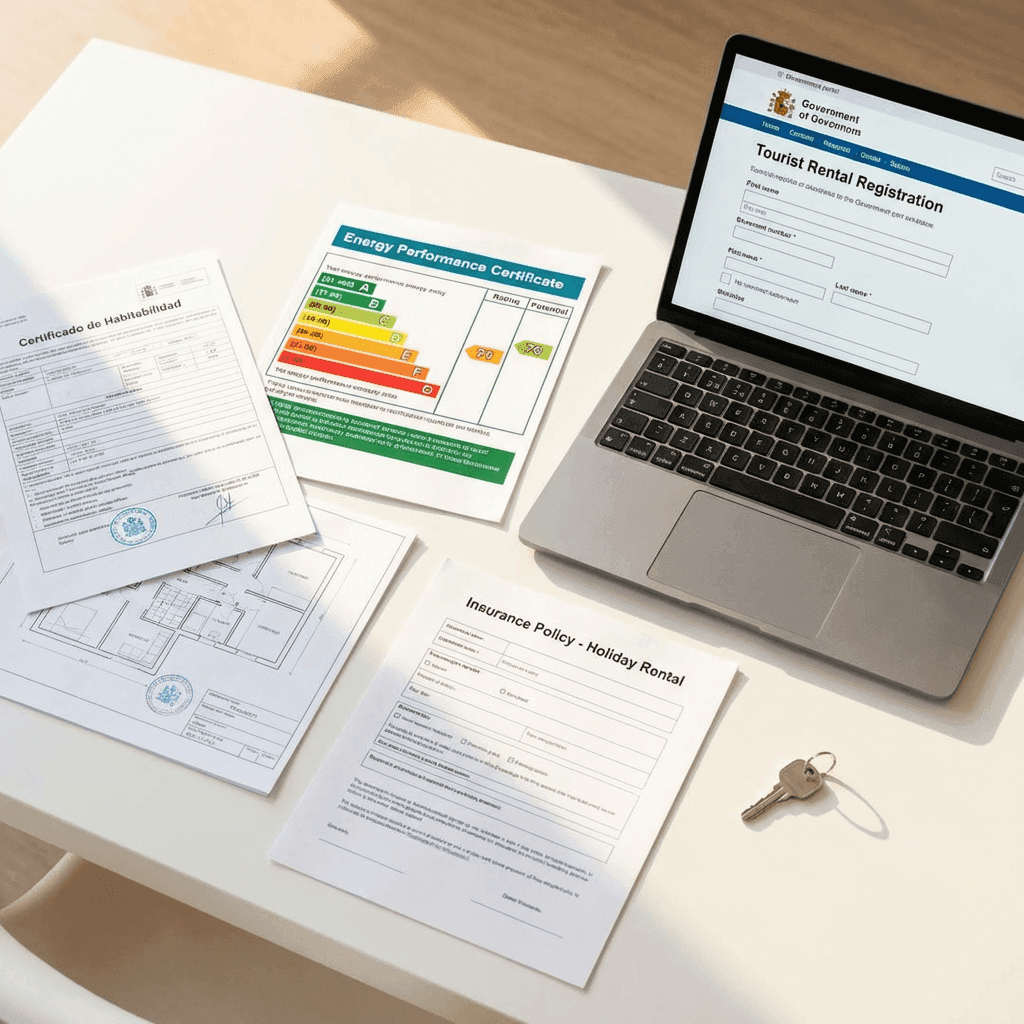
How to register your tourist rental property in Spain: step-by-step guide
The complete process to register your property as a vacation rental in Spain: prior documentation, responsible declaration, national registration number, SES Hospedajes setup, and platform listing.
10 mistakes new vacation rental owners make in Spain (and how to avoid them)
The most common mistakes made by new vacation rental owners in Spain: from operating without a license to ignoring guest registration, plus fines, neighbor conflicts, and inspections. A practical guide to not tripping up.

Vacation rental requirements by autonomous community in Spain
Detailed guide to the requirements each Spanish autonomous community demands to operate a vacation rental: licenses, responsible declarations, deadlines, limits, and key particularities.
Ready to automate your guest registration?
Create your account and start streamlining SES Hospedajes compliance for your Spanish rentals.
Get started