Fines for renting without a tourist license in Spain: how much they cost and how to avoid them
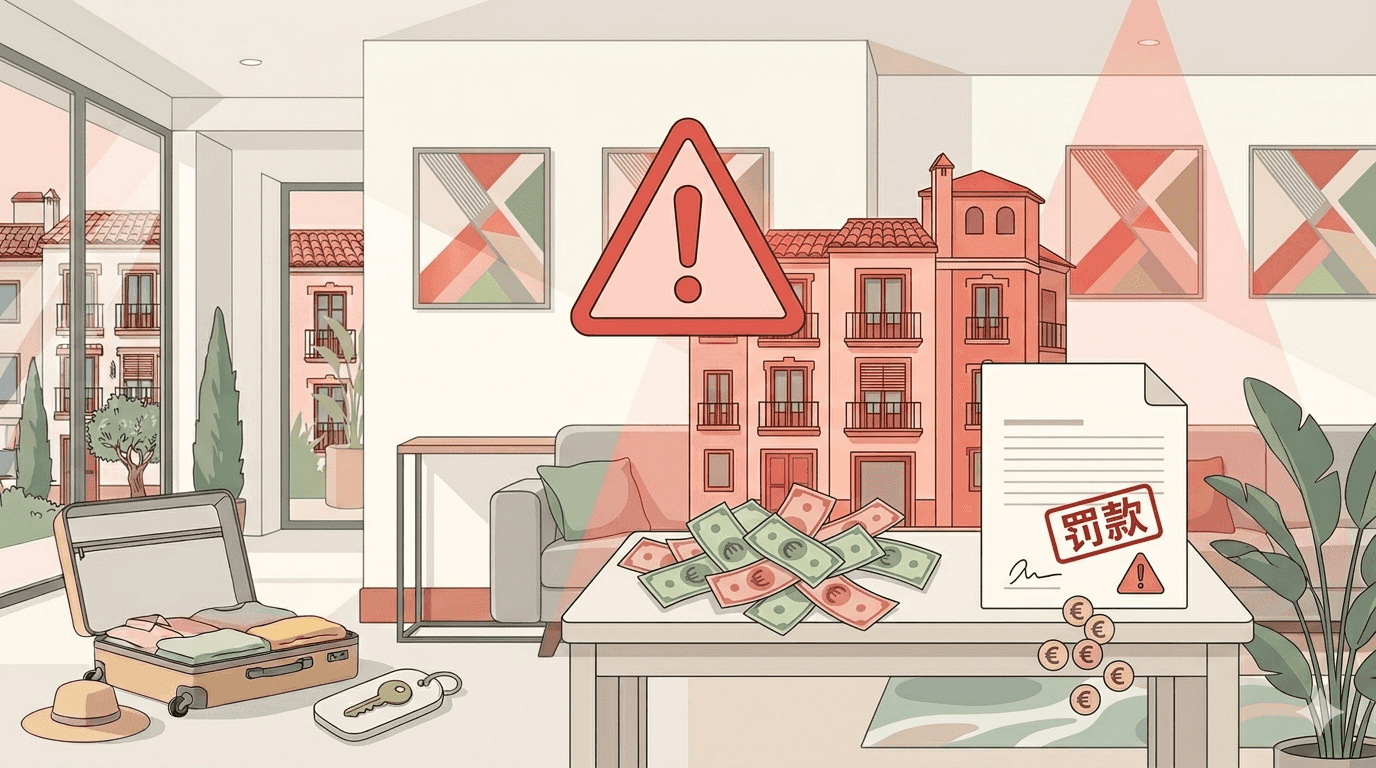
Renting your property to tourists without a license in Spain can cost you between €600 and €600,000 in fines, depending on the autonomous community and the severity of the infraction. Since 2025, platforms are required to verify the national registration number before publishing listings, making it increasingly difficult to operate without being registered. This guide details penalties by territory, how infractions are detected, and how to regularize your situation.
"Nothing will happen, everyone rents without a license." It's the most repeated phrase in owner forums. And the most expensive one.
The reality is that Spanish authorities — regional and municipal — have intensified vacation rental oversight in recent years. Detection tools are increasingly sophisticated, platforms are required to cooperate, and penalties are real. Not theoretical — real.
This guide explains exactly what you're risking, how you can get caught, and what to do if you're operating without being in compliance.
The legal framework: why you need a license
In Spain, vacation rental is regulated at three levels:
Regional level
Each autonomous community has its own regulations on tourist-use properties (VUT). In all of them, you need to file a responsible declaration or apply for a license before operating. This process gives you a registration number in the regional tourism registry.
National level
Since July 2025, Royal Decree 1312/2024 requires a national registration number for every short-stay property listed on digital platforms. Platforms must verify this number before publishing the listing.
Municipal level
Many city councils have added their own regulations: zoning, moratoriums, density limits, additional requirements. Complying with regional regulations doesn't exempt you from municipal ones.
Operating without complying with any of these three levels is a sanctionable infraction.
How much fines cost: by autonomous community
Penalties vary enormously by territory and severity. Here's the range by community:
| Autonomous community | Minor infraction | Serious infraction | Very serious infraction |
|---|---|---|---|
| Andalusia | €200 – €2,000 | €2,001 – €18,000 | €18,001 – €150,000 |
| Aragon | €600 – €6,000 | €6,001 – €60,000 | €60,001 – €600,000 |
| Balearic Islands | €4,001 – €40,000 | €40,001 – €400,000 | €400,001 – €4,000,000 |
| Canary Islands | €600 – €6,000 | €6,001 – €60,000 | €60,001 – €600,000 |
| Catalonia | €3,001 – €30,000 | €30,001 – €300,000 | €300,001 – €600,000 |
| Madrid | €600 – €6,000 | €6,001 – €60,000 | €60,001 – €600,000 |
| Valencia | €600 – €6,000 | €6,001 – €60,000 | €60,001 – €600,000 |
| Basque Country | €600 – €6,000 | €6,001 – €60,000 | €60,001 – €600,000 |
Note: The Balearic Islands have the most severe penalty regime in Spain. Fines for operating without a license in Mallorca or Ibiza have reached six-figure amounts in real cases.
What constitutes each infraction type
- Minor: minor regulatory non-compliance (missing identification plaque, complaint forms not available, incomplete listing information).
- Serious: operating without a responsible declaration or license, not having liability insurance, not registering guests, publishing without a registration number.
- Very serious: repeat serious infractions, operating after a cease order, obstructing inspection, document fraud.
Operating without a license is typically classified as a serious infraction, with fines starting at €6,000 in most communities.
How infractions are detected
Platform monitoring
Regional and municipal authorities actively monitor vacation rental platforms. They use software that:
- Identifies listings without a visible registration number
- Cross-references listings with the regional tourism registry
- Detects listings in areas where vacation rental is restricted or prohibited
- Monitors new listings in real time
Barcelona, Palma, Madrid, and Valencia have been especially active in this type of monitoring.
Neighbor complaints
One of the most frequent detection sources. Neighbors bothered by noise, suitcase traffic, or guest behavior report to the city council or local police. The complaint triggers an inspection.
Proactive inspections
Tourism inspections can be random or targeted. Inspectors verify:
- Existence of license/responsible declaration
- Registration number visible on the listing and property
- Valid civil liability insurance
- Guest registration with SES Hospedajes
- Habitability conditions and equipment
Data cross-referencing with tax authority
The tax authority receives Form 179 from platforms (each host's income) and can cross-reference it with the tourism registry. If you declare vacation rental income but don't have a license, the discrepancy can trigger both a tax and an administrative proceeding.
Platform obligations
Since the national registry came into force (RD 1312/2024), platforms are required to:
- Request the registration number from hosts
- Verify the number is valid
- Not publish listings without a verified registration number
- Cooperate with authorities by providing host data
This means operating without registration is increasingly difficult technically, not just legally.
Beyond the fine: other consequences
Activity closure
The administration can order immediate cessation of tourist activity. This means removing all listings and stopping guest reception until you regularize your situation.
Platform blocking
If a platform detects you're operating without a license (or receives a communication from the administration), it can block your listing and, in serious cases, suspend your account. Accumulated reviews and history are lost.
Liability for damages
If a guest has an accident in your property and you don't have a license or insurance, your liability is total and uncovered. Any claim comes out of your pocket.
Administrative record
Penalties are recorded. If you want to regularize your situation in the future, the record can complicate the process or result in more intense scrutiny.
Real cases
Without getting into personal data, these are examples of real penalties published in media:
- Palma de Mallorca (2024): €40,000 fine for an owner renting an apartment without a tourist license in a restricted zone.
- Barcelona (2023): €60,000 fine for operating a tourist apartment without registration in the Catalonia Tourism Registry.
- Madrid (2024): €12,000 fine for renting without a responsible declaration in the Centro district.
- Valencia (2023): €8,000 fine for operating without an urban compatibility certificate.
These aren't extreme cases — they're the typical range for serious infractions for operating without a license.
How to regularize your situation
If you're operating without a license and want to get compliant, the process is:
1. Stop renting temporarily
While you regularize, don't accept new bookings. Honor existing reservations if canceling creates more problems, but don't generate new ones.
2. Verify you can operate
Before starting paperwork, confirm your property can be used for tourist purposes:
- Your territory's regional regulations
- Municipal regulations (zoning, moratoriums)
- Homeowners' association bylaws
If there's a prohibition or restriction affecting you, regularizing isn't possible and you must cease the activity.
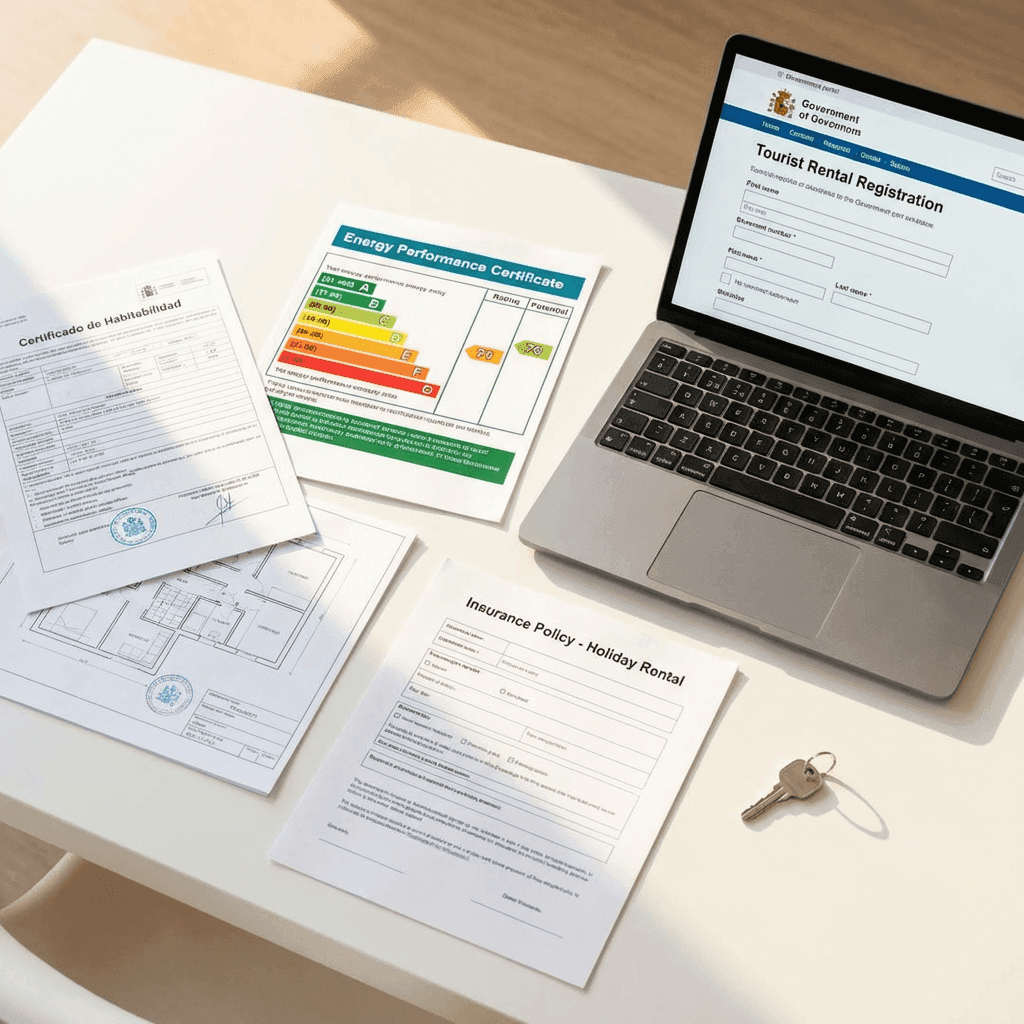
3. Gather documentation
- Habitability certificate
- Energy certificate (if required by your community)
- Civil liability insurance
- Owner documentation
Check our step-by-step guide to registering your property for full details.
4. File the responsible declaration
With your autonomous community's tourism registry. You'll receive your tourism registration number.
5. Apply for the national registration number
Under RD 1312/2024. You'll need the regional registration number as a prerequisite.
6. Register with SES Hospedajes
To be able to send mandatory guest reports from the first booking.
7. Update your listings
Include the registration number on all your listings and on the property (identification plaque).
Estimated regularization timeline
| Process | Time |
|---|---|
| Prior documentation | 1-3 weeks |
| Responsible declaration | Immediate to 2 weeks |
| National registration | 1-4 weeks |
| SES Hospedajes setup | 1-2 days |
| Total | 3-8 weeks |
Can I be fined for the period I operated without a license?
Yes. Regularizing your situation doesn't extinguish previous infractions. If the administration detects you operated without a license during a period, they can penalize you for that period even if you're now compliant.
That said, voluntarily regularizing before being detected is usually a mitigating factor in penalty proceedings. It's better to get compliant proactively than to wait to get caught.
How Autoregistro fits in
Autoregistro doesn't give you the license — that's an administrative process you must complete yourself. But once you're compliant, Autoregistro ensures you meet the guest registration obligation from day one, without fail.
Guest registration with SES Hospedajes is an obligation independent of the tourist license, and non-compliance carries its own penalties (up to €600,000). Many owners who regularize their license forget about this second obligation. Autoregistro covers it automatically: the guest completes their data, reports are sent to SES, and signatures are archived.
Having your license in order and guest registration automated protects you from the two main sources of penalties in Spanish vacation rental.
Related posts
How to register your tourist rental property in Spain: step-by-step guide
The complete process to register your property as a vacation rental in Spain: prior documentation, responsible declaration, national registration number, SES Hospedajes setup, and platform listing.
10 mistakes new vacation rental owners make in Spain (and how to avoid them)
The most common mistakes made by new vacation rental owners in Spain: from operating without a license to ignoring guest registration, plus fines, neighbor conflicts, and inspections. A practical guide to not tripping up.
What is Spain's national registration number (NRUA) and how do I get one?
Everything you need to know about Spain's Número de Registro Único de Alquiler (NRUA): what it is, why you need it, who must apply, how to get it step by step, and what happens without one.

Vacation rental requirements by autonomous community in Spain
Detailed guide to the requirements each Spanish autonomous community demands to operate a vacation rental: licenses, responsible declarations, deadlines, limits, and key particularities.
Ready to automate your guest registration?
Create your account and start streamlining SES Hospedajes compliance for your Spanish rentals.
Get started