Electricity Consumption in Tourist Accommodation: How to Control Your Bill Without Your Guests Feeling Cold
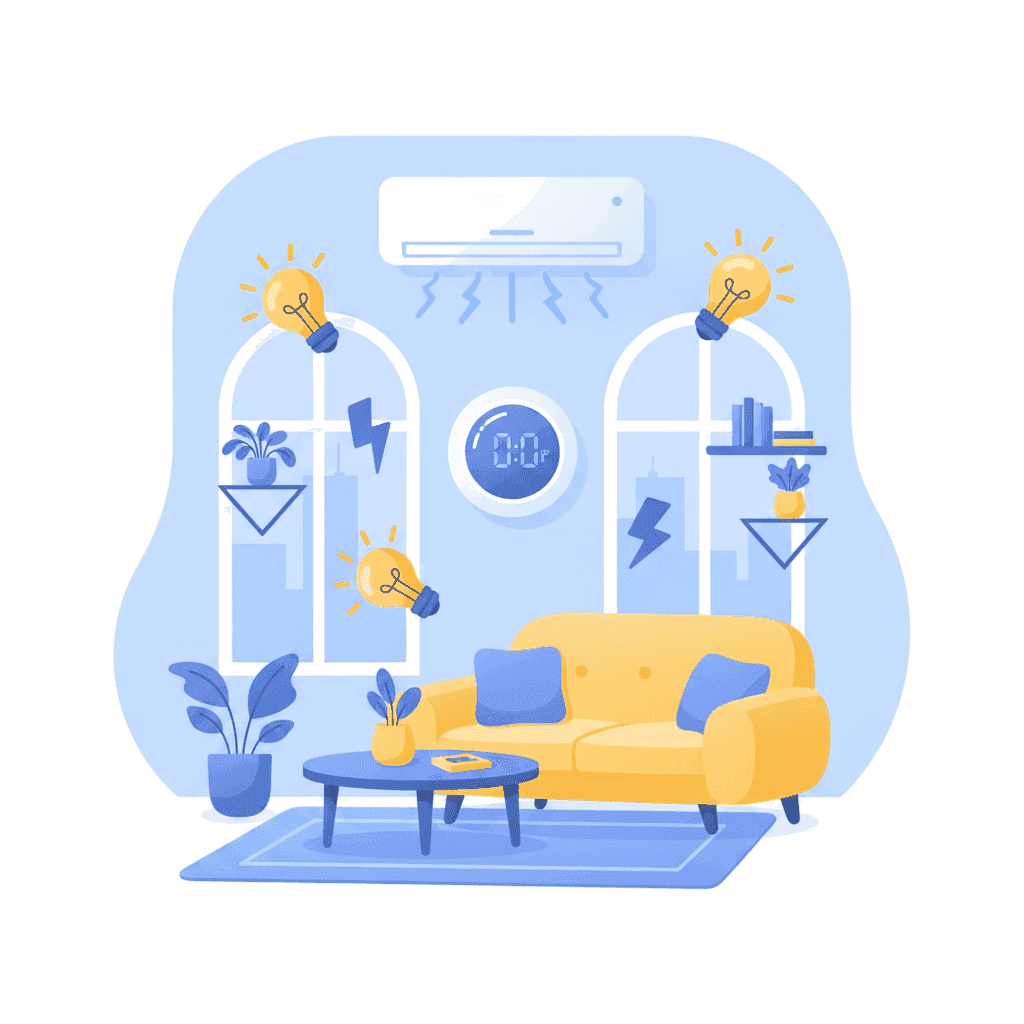
The electricity bill is one of those expenses that surprises almost all novice owners. Guests don't pay, so they set the air conditioning to 18 in August, leave the heating at 25 in January, and go on excursions with everything on. In this post, I tell you how much a typical tourist accommodation actually consumes, which electricity rate is best for you, and specific tricks to lower the bill without your guests giving a bad review.
Why does electricity spike the bill in a tourist accommodation
A regular home in Spain consumes between 2,500 and 3,500 kWh per year. A well-occupied tourist accommodation can easily go up to 5,000 or 6,000 kWh. Why? For three simple reasons:
- The guest doesn't pay, so they don't care about consumption.
- Aggressive climate control: air conditioning at maximum in summer, exaggerated heating in winter.
- Different habits: longer showers, half-load washing machines, lights on all day.
It's normal. It's not malice; it's basic psychology: what you don't pay for, you don't take care of.
A well-managed tourist apartment in a warm area can spend between 80 and 200 euros a month just on electricity. And in August, with the air conditioning on 24/7, it can go over 300 euros without a problem.
How much does a tourist accommodation really consume: real numbers
Let's look at concrete data. For a 60-70 m2 apartment with two guests and 70% occupancy, these are the usual ranges:
| Area | Average annual consumption | Estimated annual bill | Peak (worst month) |
|---|---|---|---|
| Mediterranean coast | 5,500-6,500 kWh | 1,400-1,800 euros | 280-350 euros (August) |
| Cold inland (Madrid, Castilla) | 6,000-7,500 kWh | 1,600-2,000 euros | 300-400 euros (January) |
| Northern coast (Asturias, Basque Country) | 4,500-5,500 kWh | 1,200-1,500 euros | 200-260 euros (winter) |
| Islands (Canary Islands) | 4,000-5,000 kWh | 1,100-1,400 euros | 220-280 euros (August) |
If your bill is well above these ranges, something is wrong: either you have old appliances, guests are abusing, or your rate is bad.
Which electricity rate is suitable for a tourist apartment
Here many make the first mistake: contracting the same rate as at home. A tourist accommodation has a completely different usage pattern.
Contracted power: neither too much nor too little
The contracted power is a fixed cost you pay whether or not you have guests. For a 60-80 m2 apartment with air conditioning, a ceramic hob, and normal appliances, 4.6 kW is usually enough. If you have powerful induction, electric oven, and two splits, you might need 5.75 kW.
Don't contract 6.9 kW "just in case". Each extra kW costs about 40 euros a year wasted.
Rate with or without time discrimination
The regulated rate (PVPC) has three segments: peak, flat, and valley. In a regular home, playing with schedules is profitable. In a tourist accommodation, not so much: guests turn on the air upon arrival (peak hour) and sleep with it on.
My recommendation: a flat rate from the free market, fixed price all day. You avoid surprises and can budget better.
Free market vs PVPC
| Option | Pros | Cons |
|---|---|---|
| PVPC (regulated) | No commitment, can be cheap in quiet months | Volatile, unpredictable peaks in summer and winter |
| Fixed free market | Predictable, easy to budget | Usually slightly more expensive on average |
| Indexed rate | Can save a lot | High risk in expensive months |
For a tourist accommodation, predictability is worth gold. A fixed rate saves you from the heart attack of the August bill.
Real tricks to lower the bill without ruining the experience
Here are the ones that really work, ordered from most impact to least.
1. Smart thermostat with limits
This has the most impact. A thermostat like Tado, Netatmo, or Cecotec allows you to:
- Set a minimum in winter (not below 19) and a maximum in summer (not above 23).
- Turn off climate control when no one is there (with sensor or geolocation).
- Schedule automatic shutdown after X hours.
Investment: 100-200 euros. Savings: 20-30% on climate control. Pays for itself in one season.
2. Inverter A+++ air conditioning
If your air conditioning is over 10 years old, it's costing you money every day. A modern inverter split consumes half. Replacing it costs 600-900 euros but recovers the investment in 2-3 years just in bills.
3. LED bulbs everywhere and motion sensors in hallways
Obvious but incredible how many people still have halogens in the bathroom. Switch everything to LED. In hallways, entryway, and bathroom, install presence sensors. Guests don't turn off lights; sensors do.
4. Low-energy appliances
A+++ fridge, washing machine, and dishwasher. If you have an old 15-year-old fridge, it's costing you 80-100 euros more per year than a new one. Replace it.
5. Insulation: windows and shutters
A poorly insulated apartment loses about 30% of climate control. If you can afford to replace with double-glazed windows, do it. If not, at least add weatherstripping on doors and windows, and lower shutters during the day in summer (see the welcome manual).
6. Window opening sensors linked to air conditioning
This is notable. There are kits that automatically turn off the air when they detect an open window. The habit of leaving the air on with the window open is a national sport among guests. This solves it.
7. Electric water heater with timer
The electric water heater is a silent greedy. Program it to heat only at specific times (morning and late afternoon/evening) and lower the water temperature to 55-60 degrees. They won't notice the difference, and you save 15-20%.
How to teach guests without seeming annoying
If you put up a sign saying "DON'T LEAVE THE AIR ON," it looks bad and nobody pays attention. What works:
- A friendly note in the manual: "to keep the house cool all day, we recommend closing shutters in the morning."
- Thermostats with configured limits (so guests can't lower below 22 in summer).
- Automatic message after check-in: "if you're going out, don't worry about turning off the air, the thermostat manages it automatically."
The idea: that the house manages itself without the guest having to think.
Costly mistakes
- Contracting more power than needed: wastes 40-80 euros a year.
- Leaving the electric water heater on 24/7 at 70 degrees: this device consumes much more than you think.
- Never reviewing your bill: sometimes they raise your rate without notice. Check your kWh every 3 months.
- Old "still working" air conditioning: it works, yes, but costs twice as much.
- Not placing the thermostat out of guest reach or without limits: a classic mistake.
If you want to see how this fits with other equipment decisions, check out these posts on heating and air conditioning and WiFi in tourist accommodation.
How much can you really save
A real example of a 70 m2 apartment in Valencia, two bedrooms, 75% occupancy:
| Concept | Before | After | Annual savings |
|---|---|---|---|
| Changed rate (fixed free market) | 1,700 euros | 1,500 euros | 200 euros |
| Smart thermostat with limits | 1,500 euros | 1,200 euros | 300 euros |
| LED and motion sensors | 1,200 euros | 1,100 euros | 100 euros |
| New A+++ air conditioning | 1,100 euros | 850 euros | 250 euros |
| Total | 1,700 euros | 850 euros | 850 euros/year |
It's not magic. It's addressing a cost that many ignore.
How Autoregistro fits in
Autoregistro doesn't lower your electricity bill, but it saves you another big consumer: the time spent sending data to SES Hospedajes every time a guest arrives. For 1 euro a month per property (less than a coffee), guests fill out a form and data automatically travels to SES. You spend that time optimizing electricity, water, or whatever is needed. Or just enjoying that coffee.
Frequently Asked Questions
Can I charge guests separately for electricity?
No. In tourist accommodation, all utilities are included in the price. If you charge separately, you're creating an atypical rental that could cause legal issues. What you can do is increase the price during high consumption months (July, August, January).
Is it worth installing solar panels in a tourist accommodation?
It depends. If the property has its own roof and high occupancy all year, it can be very profitable. Typical amortization: 6-8 years. In an apartment in a block, it's usually not feasible.
What minimum power should I contract?
For a 60-80 m2 apartment with air conditioning, 4.6 kW is standard. If you have induction hob, electric oven, and two splits running simultaneously, go up to 5.75 kW. More than 6 kW only if it's a large house with a heated pool or similar.
Is electric or gas heating better in tourist accommodation?
Generally, natural gas is cheaper if accessible. If not, a heat pump with inverter air conditioning is the most efficient. Pure electric radiators are the most expensive option.
How do I prevent guests from leaving the air conditioning on when they leave?
The most effective solution is a smart thermostat with presence sensors or linked to window opening detection. Signs and notices are of little use. Technology does the job.
Related posts
Heating and air conditioning in holiday homes: what to install, how much you spend, and how to avoid crazy bills
Practical guide to choosing a climate control system in your vacation rental: types, actual installation and consumption costs, and how to prevent your guests from skyrocketing your electricity bill.
WiFi in Vacation Rental Homes: Which Router to Install, What Speed to Contract, and How to Avoid 1-Star Reviews
WiFi is the number one amenity for guests. We tell you what speed to contract, which router to install, how to properly cover the entire floor, and how to prevent a connection cut from costing you a negative review.

Welcome Manual for Your Vacation Rental: What to Include, How to Do It, and Why It Saves You Problems
A good welcome manual reduces messages, avoids misunderstandings, and improves reviews. I tell you what to include, how to structure it, and common mistakes I see in novice owners.
Ready to automate your guest registration?
Create your account and start streamlining SES Hospedajes compliance for your Spanish rentals.
Get started