Technical requirements for a vacation rental in Spain: what your property must have
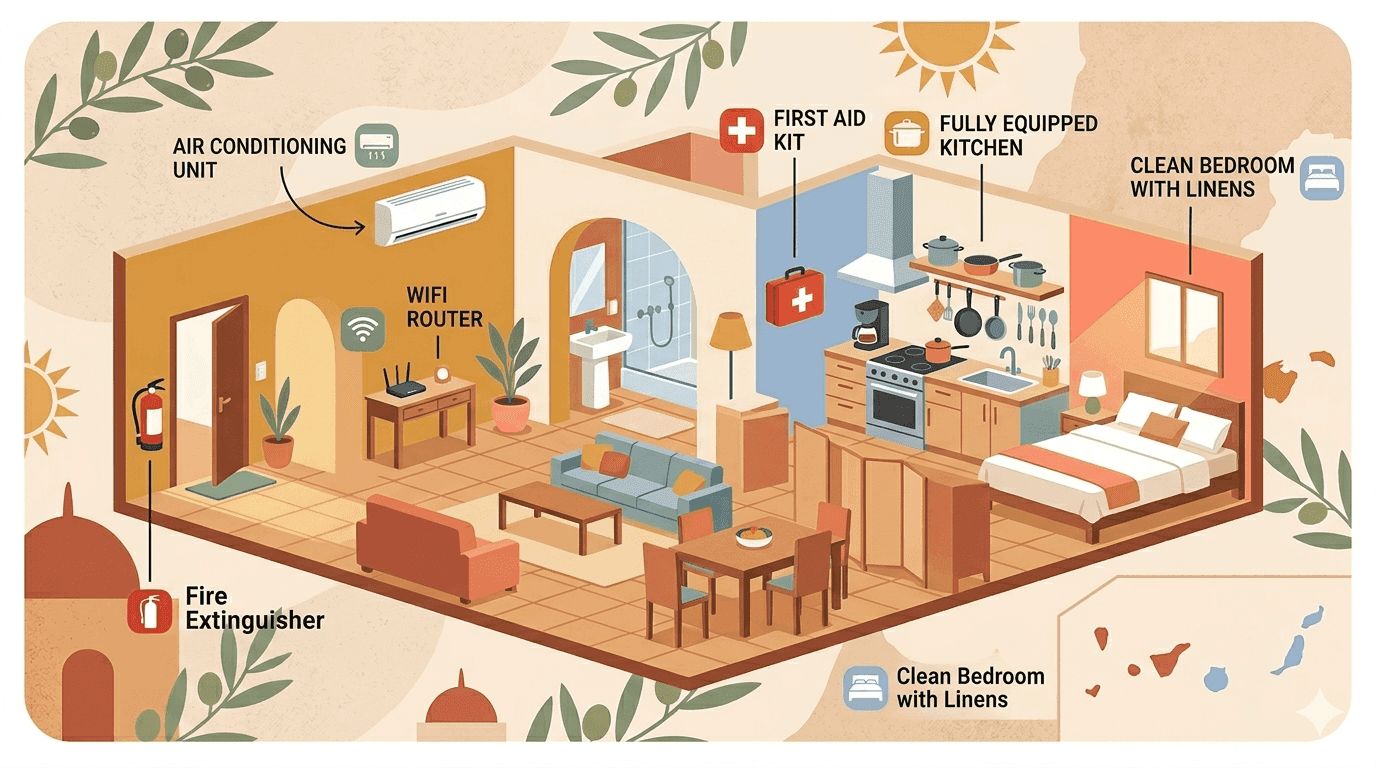
A tourist-use property in Spain must meet technical requirements that go beyond having a bed and a bathroom. Each autonomous community demands specific conditions for habitability, equipment, climate control, safety, and documentation. Failing to meet them can prevent you from obtaining a license or result in penalties during an inspection.
Many owners focus on getting the license and publishing their listing, but overlook the technical requirements their autonomous community demands. And they're not optional: an inspection can verify that your property meets minimum conditions, and if it doesn't, the consequence can range from a fine to license revocation.
This guide covers the technical requirements common to most autonomous communities and highlights the most relevant particularities of each territory.
Requirements common to all communities
Although each autonomous community has its own regulations, there's a set of requirements that appear in virtually all of them:
Habitability certificate or first occupancy license
This is the prerequisite for everything else. The property must have a valid habitability certificate (or first occupancy license, depending on your community's terminology). This document certifies that the property meets minimum conditions for habitation: surface area, ventilation, lighting, basic installations.
Without this document, you cannot obtain a tourist license in most communities.
How to get it: apply at your town hall or your autonomous community's housing department. If the property is new construction, it usually comes with the first occupancy license. If it's older, you may need a technical inspection.
Minimum surface area
Most communities require a minimum surface area per property and per room:
| Space | Typical minimum area |
|---|---|
| Complete property | 25-40 m² (varies by region) |
| Double bedroom | 10-12 m² |
| Single bedroom | 6-8 m² |
| Living-dining room | 14-18 m² |
| Kitchen | 5-7 m² (or integrated into living room) |
| Bathroom | 3-4 m² |
These figures are indicative. Check your community's specific regulations.
Natural ventilation and lighting
All main rooms (bedrooms and living room) must have natural ventilation and direct natural light from the exterior. Interior rooms without windows are not accepted as guest bedrooms.
Bathrooms may have forced ventilation (extractor fan) if they don't have an exterior window, but this varies by community.
Hot water
The property must have hot water in the kitchen and bathroom. It seems obvious, but it's an explicit requirement in the regulations and is verified during inspections.
Mandatory equipment
Bedrooms
Minimum equipment requirements for each bedroom typically include:
- Bed with mattress in good condition (minimum dimensions by type: single 90×190 cm, double 135×190 cm)
- Complete bed linen: sheets, pillows, pillowcases, blanket or duvet
- Wardrobe or storage space with hangers
- Bedside table or equivalent surface
- Individual lighting (bedside lamp or wall sconce)
- Blinds, curtains, or blackout system
Some communities specify the minimum number of hangers (usually 3-5 per person) or require a mirror in the bedroom.
Bathroom
The bathroom must have:
- Sink with mirror
- Toilet
- Shower or bathtub with screen or curtain
- Towels (minimum 2 per guest: body and hand)
- Soap or shower gel
- Toilet paper
- Waste bin
- Power outlet near the mirror (for hairdryer, shaver, etc.)
Several communities require at least one full bathroom per 4 guest places. If your property has capacity for 6 people, you'll need 2 bathrooms.
Kitchen
The kitchen must be equipped with:
- Refrigerator with freezer
- Stovetop or cooktop (minimum 2 burners)
- Oven or microwave (some communities accept microwave only)
- Sink with hot and cold water
- Basic kitchenware: plates, glasses, cutlery, frying pan, pot, coffee maker (in sufficient quantity for authorized places)
- Basic cleaning products
- Trash bin
Some communities also require a toaster, kettle, or coffee maker as minimum equipment.
Living-dining room
- Table and chairs for the number of authorized places
- Sofa or sufficient seating
- Television (not mandatory in all communities, but in most)
Climate control: heating and air conditioning
This is one of the areas where requirements vary most by autonomous community and climate zone.
Heating
Virtually all communities require heating. The type may vary:
- Central or individual heating (radiators, underfloor heating)
- Heat pumps (air conditioning with heating function)
- Electric or gas heaters (accepted in some communities as a minimum solution)
In coastal areas with mild winters, some communities are more flexible. In interior or mountain areas, the requirement is strict.
Air conditioning
Not all communities explicitly require it, but in practice:
- Andalusia, Murcia, Valencia, and the Balearic Islands require it or consider it essential due to summer temperatures
- In Madrid, Catalonia, and other interior communities, it's highly recommended though not always mandatory
- In the Canary Islands, natural ventilation is usually sufficient in many areas
Practical tip: even if your community doesn't require it, not having air conditioning in an area with hot summers will destroy your reviews and occupancy. It's an investment that pays for itself.
Climate control summary table by community
| Community | Heating | Air conditioning |
|---|---|---|
| Andalusia | Mandatory | Mandatory (cooling) |
| Aragon | Mandatory | Recommended |
| Asturias | Mandatory | Not required |
| Balearic Islands | Mandatory | Mandatory |
| Canary Islands | By zone | Not required (natural ventilation) |
| Cantabria | Mandatory | Not required |
| Castilla-La Mancha | Mandatory | Recommended |
| Castilla y León | Mandatory | Recommended |
| Catalonia | Mandatory | Recommended |
| Valencia | Mandatory | Mandatory |
| Extremadura | Mandatory | Recommended |
| Galicia | Mandatory | Not required |
| Madrid | Mandatory | Recommended |
| Murcia | Mandatory | Mandatory |
| Navarre | Mandatory | Not required |
| Basque Country | Mandatory | Not required |
| La Rioja | Mandatory | Recommended |
Internet connection (wifi)
Wifi has become an almost universal requirement:
- Most communities explicitly require it in their regulations
- Those that don't legally require it consider it an essential market standard
- It must be broadband with sufficient speed for streaming and video calls
Recommended speed: minimum 50 Mbps download. If your property has capacity for 6+ people, consider 100 Mbps or more. Guests work remotely, make video calls, and stream simultaneously.
Tip: include connection instructions (network name and password) in a visible place in the property and in the welcome message.
Safety
Mandatory requirements in most communities
- Security lock on the main door
- First aid kit with basic supplies (bandages, antiseptic, gauze, scissors)
- Fire extinguisher (mandatory in some communities; recommended in all)
- Smoke detector (mandatory in several communities; highly recommended)
- Emergency information visible: emergency phone numbers (112), nearest hospital, police station
Electrical and gas safety
- Electrical installation with grounding and circuit breaker
- Gas installation inspection (if applicable) with valid certificate
- Gas water heater with adequate ventilation (never in enclosed spaces without ventilation)
Swimming pool (if applicable)
If the property has a private pool:
- Perimeter fencing with safety lock (mandatory in many communities)
- Depth signage
- Basic rescue equipment (life ring or pole)
- Visible usage rules
Mandatory documentation in the property
You must have available in the property (physically or digitally):
Complaint forms
Mandatory in all autonomous communities. They must be available to the guest upon request. You can have them in physical format or indicate how to access them electronically.
Tourist information
Many communities require you to provide information about:
- Local tourist resources
- Public transportation
- Emergency services (hospital, pharmacy, police)
- Useful phone numbers
Property instructions
Not always an explicit legal requirement, but a good practice that prevents problems:
- Appliance operation
- Air conditioning/heating instructions
- Homeowners' association rules (noise hours, pool use, etc.)
- Waste management (recycling)
- Wifi password
Tourist registration number
Your registration number must be visible on:
- Your listing on platforms
- The property entrance (some communities require it on an exterior plaque)
- Documentation you provide to guests
Accessibility
Accessibility regulations vary significantly:
- Tourist properties on the ground floor or with elevator don't usually have additional accessibility requirements
- Some communities require a percentage of tourist properties from the same owner to be accessible
- If your property is accessible, highlight it in your listing — it's a competitive differentiator
Quick verification checklist
Before applying for your license, verify that your property meets these minimums:
| Requirement | ✓ |
|---|---|
| Valid habitability certificate | ☐ |
| Minimum surface area per room | ☐ |
| Natural ventilation and lighting in bedrooms | ☐ |
| Hot water in kitchen and bathroom | ☐ |
| Heating | ☐ |
| Air conditioning (if your region requires it) | ☐ |
| Broadband wifi | ☐ |
| Complete kitchen equipment | ☐ |
| Bed linen and towels | ☐ |
| Security lock | ☐ |
| First aid kit | ☐ |
| Fire extinguisher | ☐ |
| Smoke detector | ☐ |
| Complaint forms | ☐ |
| Emergency information | ☐ |
| Visible registration number | ☐ |
What happens if you don't meet the requirements?
The consequences depend on severity and your autonomous community:
- Inspection with minor deficiencies: deadline to fix them (usually 1-3 months)
- Serious deficiencies: temporary license suspension until corrected
- Repeated non-compliance: license revocation and fine
- Operating without meeting minimum requirements: fines from €3,000 to €30,000 depending on community and severity
How Autoregistro fits in
Autoregistro focuses on guest registration and communication with authorities, not on verifying technical requirements. But by correctly managing the documentary and registration side — which is another mandatory requirement — it lets you focus on keeping the property in shape. An owner who has automated guest registration has more time and less stress to ensure that equipment, cleaning, and maintenance meet the standards the regulations demand.
Related posts
How to register your tourist rental property in Spain: step-by-step guide
The complete process to register your property as a vacation rental in Spain: prior documentation, responsible declaration, national registration number, SES Hospedajes setup, and platform listing.
10 mistakes new vacation rental owners make in Spain (and how to avoid them)
The most common mistakes made by new vacation rental owners in Spain: from operating without a license to ignoring guest registration, plus fines, neighbor conflicts, and inspections. A practical guide to not tripping up.
What insurance do you need for your vacation rental in Spain?
Complete guide to mandatory and recommended insurance for tourist-use properties in Spain: civil liability, home, non-payment, legal protection, and specific coverages you should demand.

Vacation rental requirements by autonomous community in Spain
Detailed guide to the requirements each Spanish autonomous community demands to operate a vacation rental: licenses, responsible declarations, deadlines, limits, and key particularities.
Ready to automate your guest registration?
Create your account and start streamlining SES Hospedajes compliance for your Spanish rentals.
Get started