Is It Legal to Rent My Property as a Vacation Rental in Spain?

Yes, renting your property as a vacation rental in Spain is legal — but it's not as simple as posting a listing on Airbnb. You need to meet a series of administrative, tax, and community requirements that vary by autonomous community, municipality, and homeowners' association. This guide explains exactly what you need to operate within the law.
It's the first question every property owner asks when considering vacation rentals. And the answer generates more questions: what license do I need? Can I do it in my region? What if my neighbors object? Let's break it down.
The Legal Framework: Three Levels
Vacation rentals in Spain are regulated at three simultaneous levels. You need to comply with all three.
Regional Level
Each autonomous community has its own regulations for tourist-use dwellings (VUT). In all of them, vacation rental is legal as long as you:
- File a responsible declaration or apply for a tourist license with the regional tourism registry
- Obtain a registration number in the tourism registry
- Meet the technical requirements your community demands (habitability, equipment, safety)
Specific requirements vary enormously. Check our guide by autonomous community for your territory's details.
National Level
Since July 2025, Royal Decree 1312/2024 requires a national registration number for every short-stay property listed on digital platforms. Platforms must verify this number before publishing the listing. Without it, you cannot legally advertise on Airbnb, Booking, or any other platform.
More information in our guide on the national registration number (NRUA).
Municipal Level
Many city councils have added their own regulations:
- Zoning: areas where vacation rental is permitted, restricted, or prohibited
- Moratoriums: temporary suspension of new licenses (Barcelona, Palma, Valencia)
- Density limits: maximum number of vacation rentals per building or neighborhood
- Additional requirements: urban compatibility certificates, minimum distances between vacation rentals
Complying with regional regulations doesn't exempt you from municipal ones. Always check with your city council.
The Homeowners' Association
Since the 2019 reform of the Horizontal Property Act, homeowners' associations can limit or prohibit vacation rentals in the building with a 3/5 majority of owners.
Before starting any paperwork, verify:
- Your community's bylaws
- Minutes from recent meetings (in case any restriction was voted)
- Whether there's any express prohibition of tourist use
If the bylaws prohibit it, you cannot legally operate even if you have a tourist license. Check our guide on vacation rental bans in homeowners' associations.
What Is NOT Vacation Rental
It's important to distinguish vacation rental from other modalities:
| Modality | Duration | Applicable law | Tourist license needed? |
|---|---|---|---|
| Vacation rental (VUT) | Days to weeks | Regional tourism law | Yes |
| Seasonal rental | 1-11 months | LAU (Urban Lease Act) | No |
| Long-term rental | 1+ years | LAU | No |
| Room rental | Variable | Depends on region | Depends |
The key is the tourist purpose and platform marketing. If you rent by the day or week to tourists through platforms, it's vacation rental and you need a license.
For a detailed comparison, check our article on vacation rental vs. long-term rental.
Steps to Operate Legally
1. Verify You Can Operate
- Regional regulations for your territory
- Municipal regulations (zoning, moratoriums)
- Homeowners' association bylaws
2. Gather Documentation
- Habitability certificate or first occupancy license
- Energy certificate (if required by your region)
- Liability insurance
- Owner documentation
3. File the Responsible Declaration
With your autonomous community's tourism registry. In most regions, the effect is immediate: you can start operating from the moment of filing.
4. Obtain the National Registration Number
Per RD 1312/2024. You'll need the regional registration number as a prerequisite.
5. Register with SES Hospedajes
To send mandatory guest reports from the first booking. This is an obligation independent of the tourist license.
6. Publish Your Listing
Include the registration number in all your listings and on the property (identification plaque if your region requires it).
Check our step-by-step guide to registering your property for the complete detailed process.
What Happens If You Operate Without Meeting Requirements?
The consequences are real and growing:
- Administrative fines: from €600 to €600,000 depending on the autonomous community. Check our guide on fines for renting without a license.
- Platform blocking: platforms are required to verify the registration number and can block your listing.
- Liability for damages: without insurance or license, any incident comes out of your pocket.
- Tax problems: operating without declaring income has its own penalties. Check our guide on not declaring income.
Frequently Asked Questions
Do I need to be the owner to rent as vacation rental?
Not necessarily. A tenant can do it with written authorization from the landlord, though the process is more complex. Check our guide on subletting as vacation rental.
Can I rent just one room?
Depends on your autonomous community. Some allow room rental with a tourist license, others don't. Generally, if you live in the property and rent a room, the regulation is different.
Is there a minimum or maximum number of days?
Varies by region. Some limit the number of days per year you can rent. Check our guide on day limits.
Do I need to register as self-employed?
Only if you offer complementary services (cleaning, breakfast, tours). If you only rent the property without services, income is taxed as real estate capital gains in income tax.
How Autoregistro Fits In
Once you have your license and are operating legally, Autoregistro handles an obligation many owners discover late: guest registration with SES Hospedajes. It's mandatory from the first booking, independent of the tourist license, and non-compliance carries its own fines of up to €600,000.
Autoregistro automates the entire process: the guest completes their data before arrival, reports are sent automatically to SES Hospedajes, and signatures are archived. So you can focus on what matters: providing a great experience for your guests.
Related posts
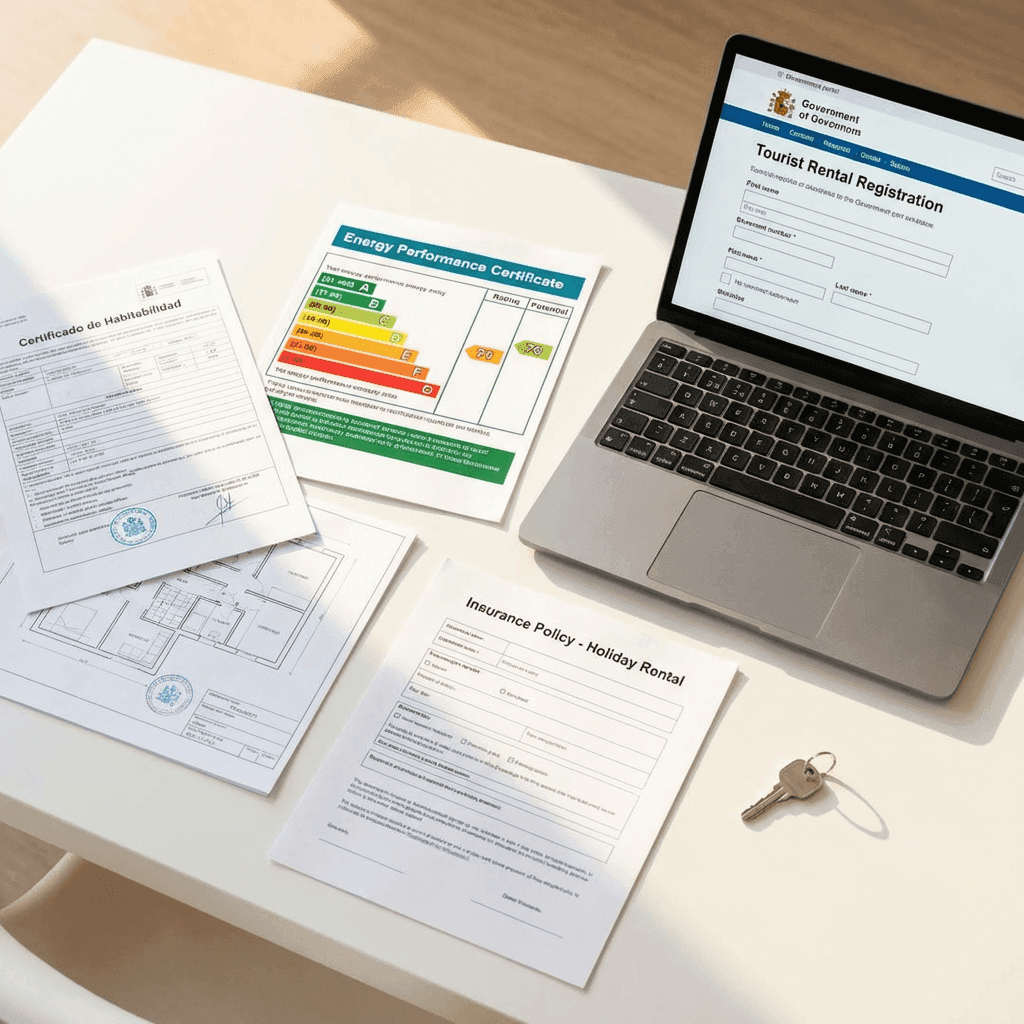
How to register your tourist rental property in Spain: step-by-step guide
The complete process to register your property as a vacation rental in Spain: prior documentation, responsible declaration, national registration number, SES Hospedajes setup, and platform listing.

Fines for renting without a tourist license in Spain: how much they cost and how to avoid them
Detailed guide on penalties for operating a vacation rental without a license in Spain: amounts by autonomous community, infraction types, how they're detected, what happens with platforms, and how to regularize your situation.
What is Spain's national registration number (NRUA) and how do I get one?
Everything you need to know about Spain's Número de Registro Único de Alquiler (NRUA): what it is, why you need it, who must apply, how to get it step by step, and what happens without one.

Vacation rental requirements by autonomous community in Spain
Detailed guide to the requirements each Spanish autonomous community demands to operate a vacation rental: licenses, responsible declarations, deadlines, limits, and key particularities.
Ready to automate your guest registration?
Create your account and start streamlining SES Hospedajes compliance for your Spanish rentals.
Get started